The Qur'an calls them pegs, hammered in so the ground under you does not sway. A careful look at what the verses actually say.
A tent in the desert survives the night wind for one reason: someone hammered pegs into the ground. Most of the peg is buried where nobody sees it, and the calm inside the tent depends entirely on the hidden part. Now listen to how the Qur'an describes the planet you are standing on: "Have We not made the earth a resting place? And the mountains as stakes?" (78:6-7). That is the answer to the question. Allah made the mountains as pegs for the earth, hammered in so the ground would hold still beneath your feet, and He said so in a book delivered to a man who lived among tents.
The Qur'an does not leave the peg image as poetry. It states the function three separate times, in three separate surahs, in almost identical words.
"And He has cast into the earth firmly set mountains, lest it shift with you, and rivers and roads, that you may be guided" (16:15). "And We placed within the earth firmly set mountains, lest it should shift with them, and We made therein passes as roads that they might be guided" (21:31). "He created the heavens without pillars that you see and has cast into the earth firmly set mountains, lest it should shift with you" (31:10).
Lest it shift with you. Three times. The mountains are not decoration on the earth. They are hardware in it, and the stated purpose is your stability. Even the verb is physical: cast, thrown down into the earth, the way a peg is driven rather than placed. And a shorter verse hammers the last nail: "And the mountains He set firmly" (79:32).
Here is where the peg image earns a second look. A peg is mostly underground. Its whole logic is that the visible part is the smaller part.
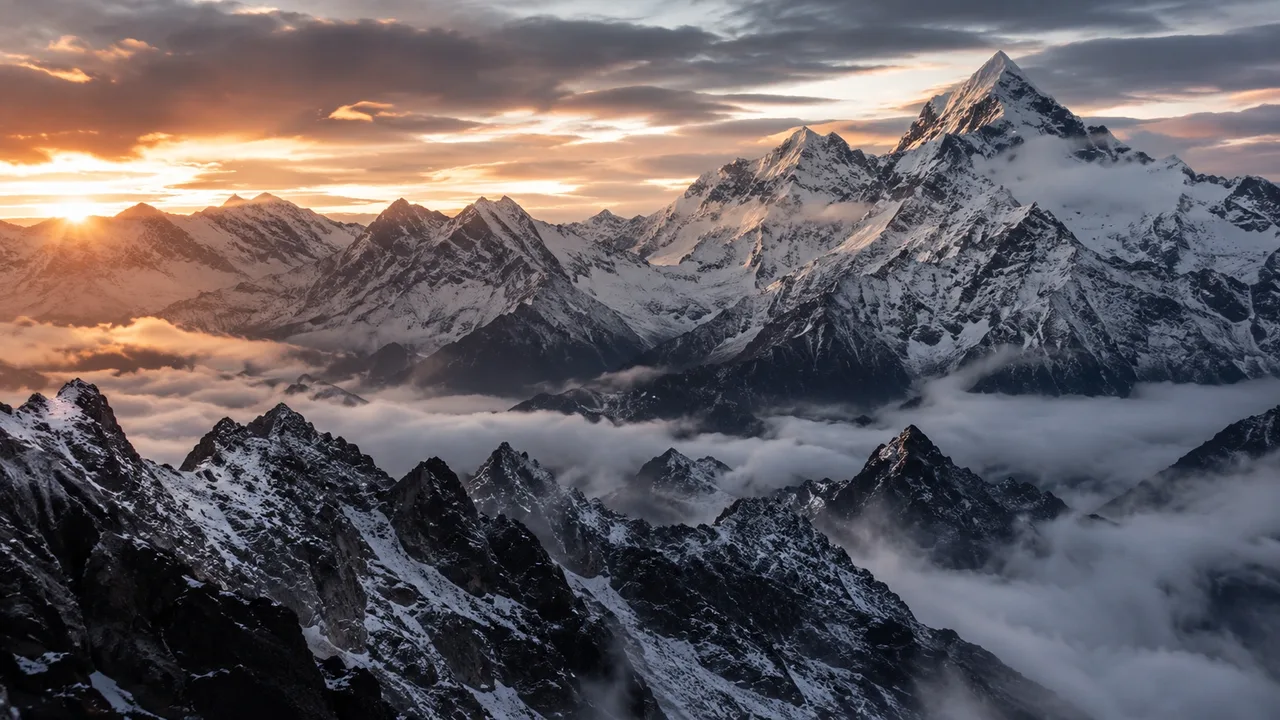
Geologists today describe mountains in strikingly similar terms: the great ranges extend roots deep down into the crust, buried masses many times the height of the visible peak, keeping the whole structure balanced in the denser rock beneath. What you see of Everest is, structurally, the top of the peg. That is a modern description laid beside a seventh-century verse, and we present it as exactly that, an observation, not a tafsir. But sit for a moment with the choice of word. Of all the images available for mountains, majesty, thrones, walls, the Qur'an chose the one whose defining feature is hidden depth, and it did so speaking of function: holding things steady.
Honesty demands a boundary here. The verses do not say there will never be earthquakes, and no reader of the news needs telling. What they say, in every occurrence, is that the earth was made a resting place and does not sway and drift with you as you live on it. You have spent your entire life on the surface of a spinning rock and never once felt the floor move beneath your morning routine. That daily, boring steadiness is the miracle the verses point at, and its pegs are visible from your window.
Notice what travels with the mountains in these verses: "rivers and roads, that you may be guided" (16:15), "passes as roads" (21:31). The same ranges that hold the crust also catch the snows, feed the rivers, and split into the passes that every trade route in history threaded through. The verse bundles them together as one gift: stability under you, water beside you, a way through.
This is the Qur'an's habit with creation. Nothing has one job. The thing anchoring the ground is also watering your crops and drawing the map of your journeys.
And it is the Qur'an's habit with you, too. These verses were first heard by traders whose entire livelihood moved through mountain passes on camelback, people who knew exactly how a journey dies when the pass is blocked and how a caravan lives on the river the peaks send down. The Book met them inside their geography. It still does. Your commute, your water supply, the weather that fills your fields, all of it is routed through the same stone furniture the verses are pointing at.
So why did Allah make the mountains? The sourced answer is short: as pegs, so the earth would rest still beneath its travellers, and as the givers of rivers and roads. But the question behind the question is why He told us. The surah that calls them stakes is not a geology lesson; it opens a list of favours designed to be read like an invoice: sleep, night, day, rain, and the ground that held still while you enjoyed all of it.
The next mountain you see, read it the way the Qur'an teaches. Not scenery. A peg, driven by a hand that wanted your tent to stand calm through the night, and mostly buried, like every mercy that holds your life together.
Silsila Research Desk
Grade: Sourced · 5 min read