
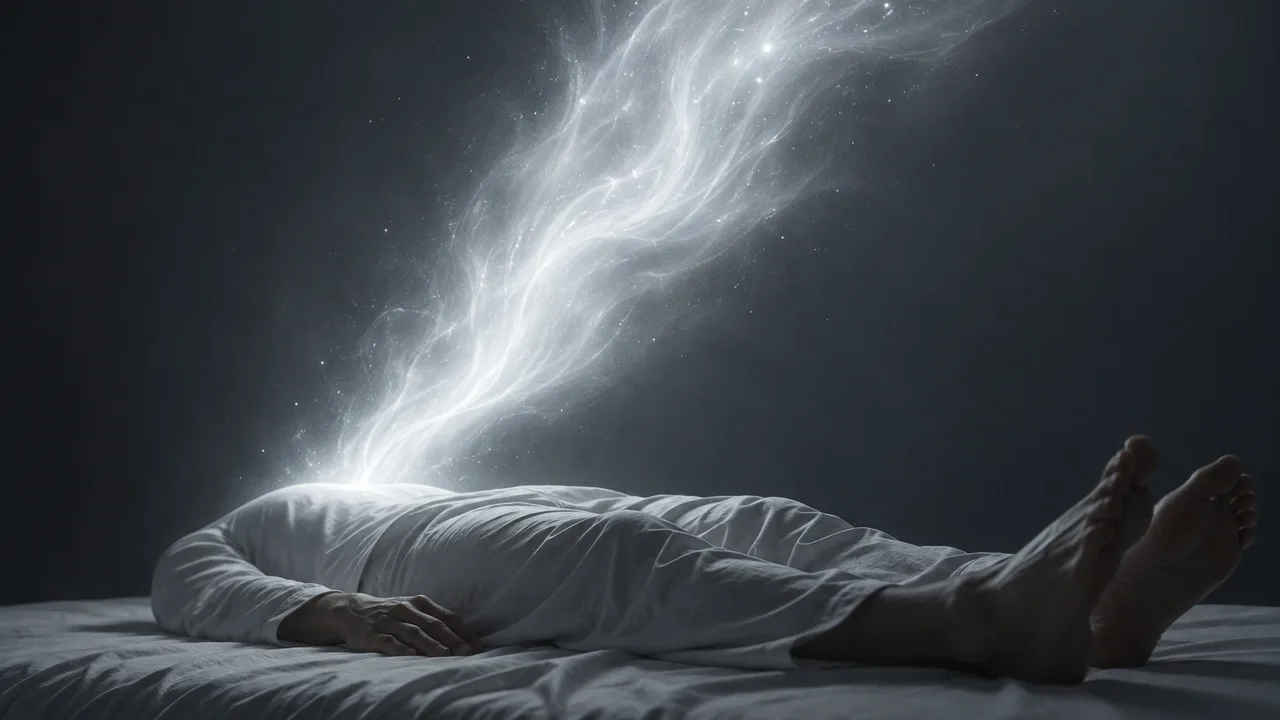
Allah kept the soul's nature deliberately hidden. Here is what He did tell us, and the one place where all answers stop.
You died last night. Something left your body while you slept, travelled beyond your reach, and this morning it was handed back, and you woke up and checked your phone as if nothing happened. The Qur'an says it plainly: "Allah takes the souls at the time of their death, and those that do not die He takes during their sleep" (39:42). So what is this thing that leaves and returns, the thing that is more you than your body is? Here is the honest answer Islam gives: its nature is a locked room. "They ask you about the soul. Say: the soul is of the affair of my Lord. And you have not been given of knowledge except a little" (17:85). The nature is hidden. But its story, where it comes from, what happens to it at death, and what it will hear at the end, that, Allah told us in detail.
People came to the Prophet ﷺ and asked him what the soul actually is. Heaven answered, and the answer was a boundary line. The soul is of the affair of my Lord. You have been given only a little knowledge.
Fourteen centuries later, that line has not moved. We can map the brain, split the atom, photograph galaxies being born. We still cannot tell you what it is that makes the difference between a living body and a body, one second after death, with nothing missing from it. Every instrument says both are identical. Every person standing at that bedside knows they are not. The thing that left has no weight, no colour, and no equation, exactly as promised.
So Islam does not define the soul. It does something more useful. It tells you the soul's itinerary.
Your body has an address in the earth. The Qur'an describes how Allah shaped man, "then He proportioned him and breathed into him from His soul and made for you hearing and vision and hearts" (32:9). The body was formed, and then something was breathed into it, and only then did hearing hear and seeing see.
That is the hierarchy hiding inside you. The eyes are equipment. The one looking through them arrived by a breath from your Lord's command. You have felt this your whole life without naming it: the strange certainty that you are not your hands or your face, that you live somewhere just behind them.
Go back to the sleep verse, because it is one of the most quietly frightening in the Qur'an. Allah takes every soul in its sleep. "Then He keeps those for which He has decreed death and releases the others for a specified term" (39:42).
Every night is a rehearsal of your death. Every morning is a decision, made about you while you were helpless, to release you one more time. Somewhere in your city last night, someone was not released. They went to sleep beside their spouse with plans for the weekend, and their soul was kept. The verse ends by saying there are signs in this for people who reflect. Most of us have slept and woken more than twenty thousand times without reflecting once.
One angel already knows your name. "Say: the angel of death who has been entrusted with you will take you. Then to your Lord you will be returned" (32:11).
And when he arrives, the leaving is not the same for everyone. The Prophet ﷺ described both exits in one long narration. The righteous soul is called out with gentleness, "O good soul, come out to the forgiveness and pleasure of your Lord," and it slips from the body with ease, and angels wrap it in a shroud of Paradise. The soul that spent its years at war with its Lord hears a different summons, and it is dragged out the way a skewer is pulled through wet wool. Same room. Same moment. Two different souls, two different exits, and the difference was written by the way each one lived.
What happens to the soul after that, the questioning, the window opened twice a day onto its final home, is its own story, and we have told it in full in the article on the grave.
Follow the soul far enough and you reach the sentence it was created to hear. At the end of Surah al-Fajr, after pages of tyrants and ruined nations, the register suddenly softens, and Allah speaks to one listener: "O reassured soul, return to your Lord, well-pleased and pleasing to Him, and enter among My servants, and enter My Paradise" (89:27-30).
Reassured. Not the brilliant soul, not the famous one. The soul that stopped fighting its Lord and settled, the way a bird settles at dusk. That is the finish line of the entire journey: to be called home, personally, and to arrive pleased.
So what is the soul? Something breathed into you from the command of your Lord. Something taken and returned every night on trust. Something with one guaranteed appointment and two possible exits. Something that will, if it settles, hear its own name called into Paradise.
What is it made of? You will find out. You will be there when the answer comes, because you are the answer's address. Until then, the wisest response to the locked room is the oldest one: stop interrogating the mystery, and start preparing the traveller.
Silsila Research Desk
Grade: Sahih · 6 min read