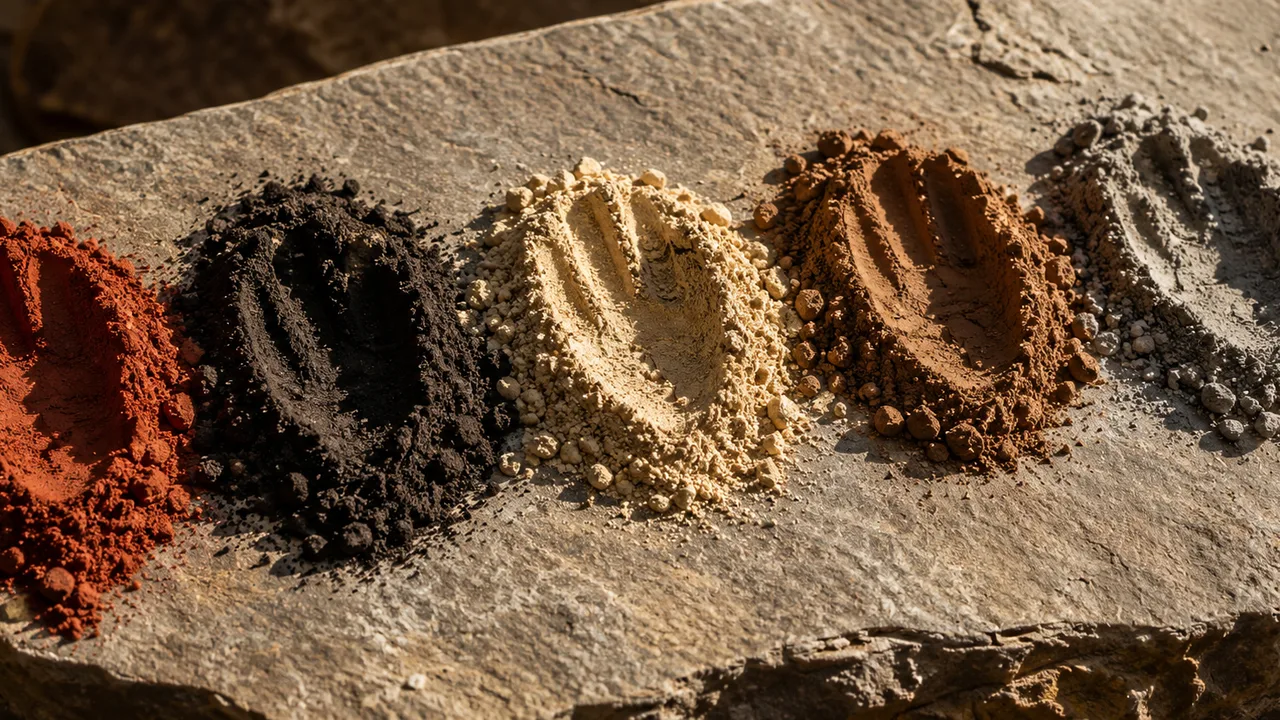
Adam (AS) was made from a handful taken from the whole earth, so his children came out the colour of the ground. What the classical books do next is harder.
Pick up a handful of the ground where you are standing. It has a colour, and it is not the colour of the ground four countries from here. Abu Musa al-Ash'ari (RA) narrated that the Prophet ﷺ said Allah created Adam (AS) from a handful He took from the whole of the earth, so the children of Adam (AS) came according to the earth. Among them came the white and the red and the black and what lies between, the smooth and the rough, the good and the foul.
That is the mechanism, and it is not a picture the books added later. It sits in Ahmad's Musnad, in Abu Dawud, in al-Tirmidhi, and in Ibn Hibban, whose chapter heading on it explains that from the skin of the whole earth means from one single handful of it. Then the Quran does something with that fact which most people read straight past. It files human colour under signs. And of His signs is the creation of the heavens and the earth and the diversity of your languages and your colours (30:22). Your skin is listed beside the sky. That is the easy half of the answer. The harder half is that the same books never stop at telling you people are equal.
Read the verses around it and you can see what kind of list this is. And of His signs is that He created you from dust, then suddenly you were human beings dispersing (30:20). Dust, then spreading, then languages and colours.
Ibn Kathir takes the languages first and simply names the peoples he knew of, Arabs and Tatars and Georgians and Byzantines and Franks and Berbers and Abyssinians and Indians and Persians and Slavs and Khazars and Armenians and Kurds, and then says the rest are known only to Allah.
Then he turns to the faces, and this is the part worth slowing down for. Every human being who has lived since Adam (AS) was made, he writes, has two eyes, two brows, a nose, a forehead, a mouth and two cheeks. The same parts, in the same places, on every head that has ever existed. And not one of them is another. There is always some difference of bearing or shape or speech, sometimes obvious, sometimes hidden until you look. Every face, he says, is a manner of its own.
Al-Qurtubi, on the same verse, turns the observation into an argument. The colours differ in the forms, he says, whiteness and blackness and redness, so that you can hardly look at anybody without telling him from somebody else. Then the hinge. None of this is the doing of the drop of fluid, and none of it is the doing of the two parents. So there must be a Doer. And this, he says, is among the strongest proofs of the One who arranges and originates.
Read that again. He is not saying variety is pleasant. He is saying variety is the fingerprint.
Surah Fatir says it plainer than any paraphrase could. Do you not see that Allah sends down rain from the sky, and We produce thereby fruits of varying colours? And in the mountains are tracts, white and red of varying shades, and some extremely black (35:27). Then the next verse, without changing the vocabulary. And among people and moving creatures and grazing livestock are various colours similarly (35:28).
Ibn Kathir reads the pair as one demonstration. What is being shown, he says, is the completeness of a power that produces things this varied out of one single thing, the water that comes down from the sky. One rain. Yellow fruit, red fruit, green, white. One range of mountains, pale rock and red rock and rock so black that Arabic keeps a separate word for it. Then people, described with the same word, in the same breath, as part of the same display.
Nobody in those verses is being ranked. They are being counted as proof.
If it stopped there this would be a comfortable page. It does not stop there.
O mankind, indeed We have created you from male and female and made you peoples and tribes that you may know one another. Indeed, the most noble of you in the sight of Allah is the most righteous of you (49:13). The peoples and the tribes are not the point. The knowing one another is the point, and then one measure is named, and it is not one anybody is born holding.
Under that verse al-Qurtubi brings the sermon the Prophet ﷺ gave at Mina in the middle days of tashriq, which Ahmad records in his Musnad from a man who was standing in the crowd. O people, your Lord is one and your father is one. No Arab has any merit over a non-Arab, and no non-Arab over an Arab, and no red over a black, and no black over a red, except by taqwa. Have I conveyed? They said yes. Let the one present carry it to the one absent.
That was not said in a private lesson. It was said on a camel, in the season, to the largest gathering he would ever address.
Years afterwards a traveller passing through al-Rabadha found Abu Dharr (RA) wearing a garment, and his servant wearing one exactly like it, and asked him why. What came back was a confession.
He had quarrelled with a man once and taunted him about his mother. Al-Bukhari files the incident under a chapter titled that sins are from the affair of jahiliyya. In the longer wording the mother was not an Arab. Ibn Hajar, working through the narrations, records one in which the words were, O son of the black woman. The books do not name the man who heard them.
The Prophet ﷺ was told, and he said to Abu Dharr (RA), you are a man in whom there is jahiliyya. In Muslim's version Abu Dharr (RA) is startled enough to ask, at this hour of my old age? He was told yes. Then came the instruction. They are your brothers. Allah has placed them under your hands. Feed them from what you eat, clothe them from what you wear, do not burden them with what defeats them, and if you do, go and help them.
Ibn Hajar reads it as a man discovering a habit he had never inspected. Then he notes what happened next. Abu Dharr (RA) took to making his servant his equal in dress and in the rest of it, taking the safer road. Which means the two matching garments at al-Rabadha, the thing the traveller asked about, were that correction still running years later. He did not apologise once and move on. He changed what he put on his body every morning for the rest of his life.
One hadith gets quoted for its strangeness and its aim gets missed. Listen and obey, the Prophet ﷺ said, even if an Abyssinian whose head is like a raisin is put in charge over you (Sahih al-Bukhari 693). He said a version of it straight to Abu Dharr (RA) as well.
Ibn Hajar explains the image without softening it. The likeness is to the compactness of the head and to black hair, and it is a picture of lowliness and of a form people find unpleasing. That is the entire design of the sentence. It reaches for the person that audience would have ranked at the bottom, sets him at the top of the chain of command, and tells them to obey.
So the answer comes in two parts and only the first one is easy. Colour came from soil, soil varied, and Allah listed the result among His signs. What the same shelf does with that is the part that costs something. It names a measure nobody inherits, it records the Messenger of Allah ﷺ correcting a Companion to his face over a single sentence, and it leaves the correction in the book.
Allah does not look at your forms and your wealth, the Prophet ﷺ said. He looks at your hearts and your deeds (Sahih Muslim, Kitab al-Birr).
Nothing on the outside of you was ever on the scale.
Silsila Research Desk
Grade: Sahih · 7 min read