
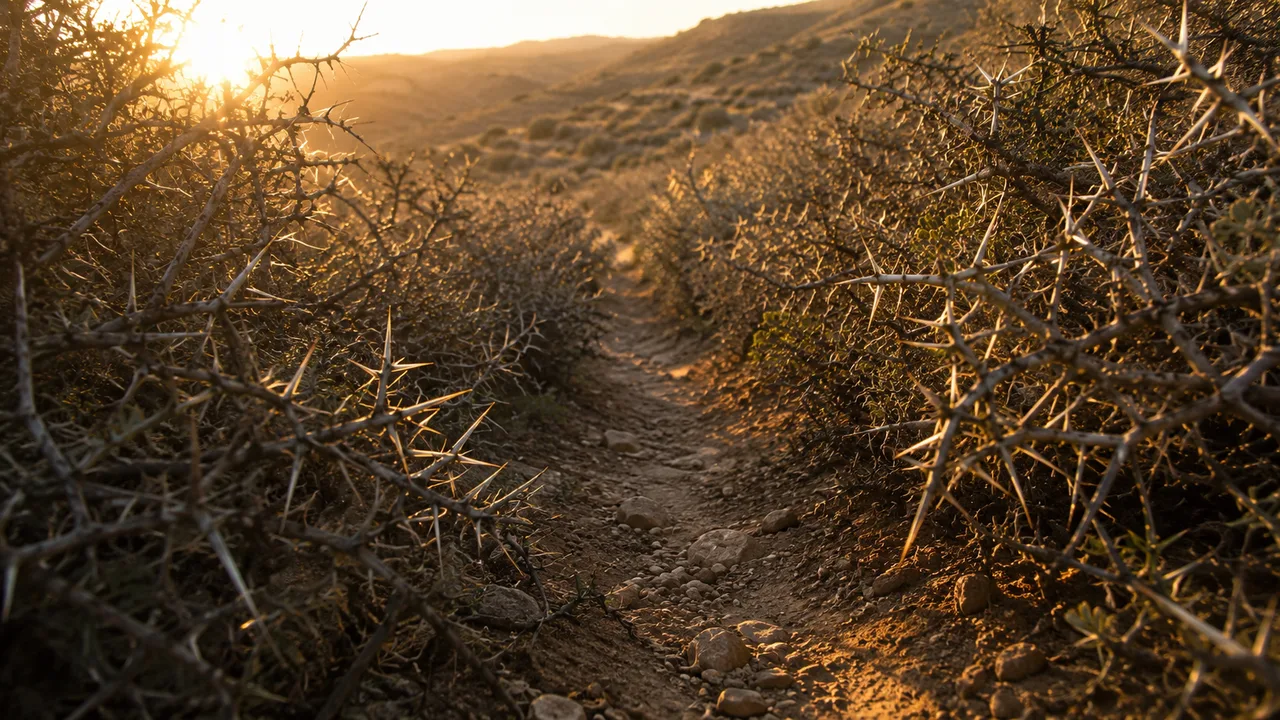
Taqwa is not fear that freezes you. It is the heart so aware of Allah it draws back from what displeases Him before it even happens.
Picture a path lined with thorns, and a man walking it who lifts the hem of his robe so nothing catches him and nothing cuts him. That image is how the companions of the Prophet Muhammad ﷺ once explained taqwa, and it is still the clearest picture of it that exists. Taqwa is the habit of a heart awake to Allah, careful enough to draw back from what displeases Him before the danger even touches you. It is not a mood. It is not fear that freezes you in place. It is a working, moving carefulness, the same instinct that makes a person lift their robe on a thorny road without being told to.
Umar ibn al-Khattab (RA) once put the question directly to a companion named Ubayy ibn Ka'b, what is taqwa. Ubayy did not answer with a definition. He asked a question back. Have you ever walked a road covered in thorns? Umar (RA) said yes. And what did you do, Ubayy asked. I rolled up my sleeves and struggled through it, Umar (RA) said. That, said Ubayy, is taqwa. Ibn Kathir records this exchange in his commentary on the opening of Surah al-Baqarah, alongside the plain root meaning of the word, to guard yourself, to avoid what harms you.
The Quran opens by naming exactly who its guidance is for. This is the Book about which there is no doubt, a guidance for those conscious of Allah, who believe in the unseen, establish prayer, and spend out of what We have provided for them, and who believe in what has been revealed to you, and what was revealed before you, and of the Hereafter they are certain in faith. Those are upon right guidance from their Lord, and it is those who are the successful (2:2 to 5). Read slowly, this is not a vague blessing thrown at everyone. The Book names its own audience, the muttaqin, the people of taqwa, and then describes them by what they do, unseen belief, standing prayer, open hands, certainty about what comes after this life. Taqwa is not the reward waiting at the end of that list. It is the soil all four grow out of.
Seventh century Arabia ran on lineage, on tribe, on which clan you were born into and which one your enemies feared. Into that world came a verse that erased the entire scale. O mankind, indeed We have created you from male and female and made you peoples and tribes that you may know one another. Indeed, the most noble of you in the sight of Allah is the most righteous of you. Indeed, Allah is Knowing and Aware (49:13). Tribes stay useful for one thing only, so people recognize each other, nothing more. The verse does not say the most noble is the richest, the strongest, or the best born. It says the most muttaqi, the one whose taqwa runs deepest. That is the only ranking that will still be standing when every other one has collapsed.
Taqwa is not only about the next life. It changes what happens to a person in this one. Whoever fears Allah, He will make for him a way out, and will provide for him from where he does not expect. And whoever relies upon Allah, then He is sufficient for him (65:2 to 3). Read that as a promise, not a proverb. A way out is being offered specifically to the person whose taqwa is real, out of a difficulty that looked sealed shut from every side, and provision arriving from a direction nobody was watching. That is not a metaphor for patience. It is stated as cause and effect.
The Quran does not let taqwa stay comfortable or partial. O you who have believed, fear Allah as He should be feared, and do not die except as Muslims in submission to Him (3:102). As He should be feared, not as much as is easy, not the version that fits around a busy week. The verse ends on death deliberately, because taqwa is not a phase a person grows out of. It is meant to be the last state a person is found in.
Before setting out for Hajj, travelers in Arabia carried food and water for the road, whatever the journey required. The Quran redirects the question of what matters most to carry. And take provisions, but indeed, the best provision is fear of Allah. And fear Me, O you of understanding (2:197). Everything else a person packs can run out somewhere along the road. This is the one provision that does not.
A gathering once heard the Prophet Muhammad ﷺ say, the Muslim is the brother of a Muslim, he does not oppress him, he does not fail him, he does not look down on him. Then he pointed to his own chest three times and said, the piety is here (Sahih Muslim 2564a). Not on the tongue. Not in how long a beard grows or how loud a person recites. In the chest, where no one else can see it, where only Allah and the person carrying it know if it is really there.
Taqwa is not a badge to display. It is the private lift of a robe on a road only you can feel the thorns of. Every verse points at the same instinct from a different angle, a heart careful enough to be guided, a rank that outlasts tribe and money, a way out arriving from nowhere you expected, a fear owed in full and carried to the grave, a provision that never runs dry, and a location no one can check but Allah. Ask yourself, on the ordinary road you are walking today, are you lifting the robe, or letting it drag?
Silsila Research Desk
Grade: Sahih · 7 min read