
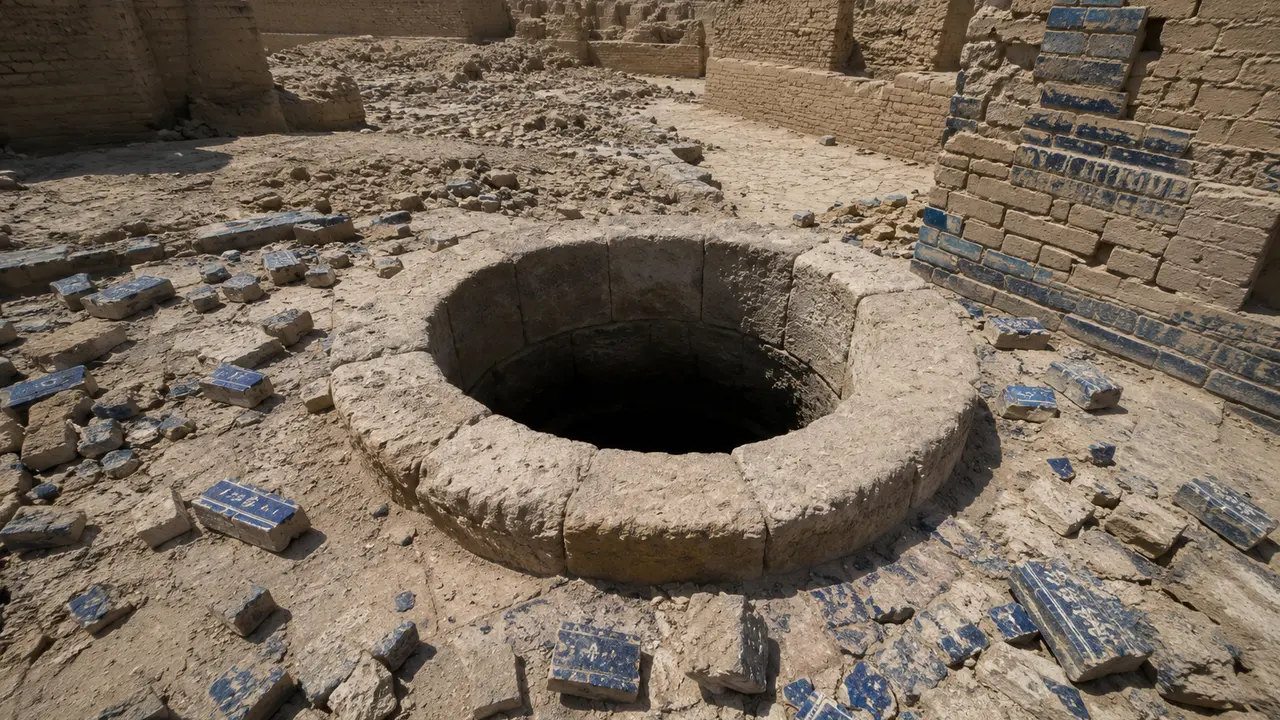
Two names, once in the whole Quran, standing at Babylon and stopping every visitor with the same warning. We are a trial, so do not disbelieve.
Two names appear in Babylon, and then never again anywhere in the Quran. Harut and Marut. Whoever came to them wanting what they had was stopped at the door by one sentence, said before a single word of instruction passed between them. We are a trial, so do not disbelieve. Read that again. It is a warning delivered to the face of a man who has already walked all the way to Babylon for something he was told not to take. He was handed the exit before he was handed the knowledge. They took the knowledge anyway.
Everything Islam actually establishes about these two sits inside one verse, 2:102, and it fits in a paragraph. They stand at Babylon. They warn every single person before teaching. What people carried away from them was the means of splitting a husband from his wife. And the same verse says flatly that none of it harms anyone except by the permission of Allah. That is the account. Everything else you have heard is commentary, and some of it is not even that.
The passage does not begin with them. It begins with people who already had the truth and put it down. When a messenger from Allah came to them confirming that which was with them, a party of those who had been given the Scripture threw the Scripture of Allah behind their backs as if they did not know (2:101). Then the verse that names Babylon. And they followed what the devils had recited during the reign of Solomon. It was not Solomon who disbelieved, but the devils disbelieved, teaching people magic and that which was revealed to the two angels at Babylon, Harut and Marut. But they do not teach anyone unless they say, We are a trial, so do not disbelieve. And yet they learn from them that by which they cause separation between a man and his wife. But they do not harm anyone through it except by permission of Allah (2:102).
Notice who the verse defends first. Sulayman (AS) had been accused of sorcery, of ruling through it, of being one of them. The Quran interrupts its own sentence to clear him before continuing. Mufti Muhammad Shafi' points out in Ma'arif al-Qur'an that the clearing is inserted as a parenthesis precisely because the accusation was so vile, a prophet slandered as a magician by people who then went looking for magic themselves. How that slander started is told in several conflicting ways in the old commentaries, so leave it where it lies. The Quran's concern is that they knew better.
The grammar is worth slowing down on. They teach no one until they have said it. Ibn Kathir records from Ibn Abbas (RA) that when a man came for this knowledge the two would push him away and tell him, we are only a test, do not fall into disbelief, and that they knew exactly where belief ended. Al-Hasan al-Basri and Qatadah are both recorded saying the two were bound by a pledge not to teach a soul until that line had been spoken.
Al-Baghawi explains the word fitnah here from its root sense, the assaying of gold and silver in fire so the good separates visibly from the worthless. That is what the two were. Not a trap laid to catch people, a fire lit to sort them. Everyone who arrived heard the same words. What each man did next was the point.
The tafsir tradition splits here, and it is honest to say so rather than pick a side and hide the other.
The standard recitation is al-malakayn, the two angels, and al-Baghawi confirms this is the known reading. On it, Harut and Marut were angels sent down, and the obvious objection follows immediately. How can an angel be anywhere near this. Al-Baghawi gives two answers. The first is that they never taught it in order to spread it, they described it, declared it false and ordered people away from it, teaching in the sense of informing, and the wretched man ignored the counsel and walked off with the craft. The second, which al-Baghawi considers stronger, is that Allah tested people through the two at that time, the wretched learned it and fell, the fortunate left it and kept their faith.
The other reading is al-malikayn with a different vowel, the two kings, and al-Baghawi reports it from Ibn Abbas (RA) and al-Hasan, with Ibn Abbas (RA) quoted saying they were simply two men, sorcerers at Babylon, and al-Hasan reasoning that angels do not know magic at all. Ibn Kathir carries a version of the same conclusion from al-Tabari, who read the negation in the verse as carrying forward so that nothing was sent down to the two either. Ibn Kathir does not accept it. He holds that many of the earliest generation took them to be angels, and lists that view through al-Qurtubi from Ali (RA), Ibn Mas'ud (RA), Ibn Abbas (RA) and Ibn Umar (RA), among others.
Look at that list and then look at the reading above it. Ibn Abbas (RA) is quoted on both sides. That is not a scandal. It is a measure of how little solid ground there is past the verse itself, and a reason to hold every reconstruction loosely and the verse tightly.
There is a long, cinematic version of Harut and Marut that circulates in lectures and posts and comment sections. Angels who mocked the sins of mankind. A descent. A beautiful woman. Wine, an idol, a murder. The two hung in punishment at Babylon until the Day of Judgment.
None of it is established, and none of it is needed. None of it is in the Quran either. Ma'arif al-Qur'an addresses the story directly and says it rests on no established Islamic report, that scholars who found it colliding with the law rejected it as fiction, while others held it could be read in a way that does not collide and so did not dismiss it outright, and that understanding the verse does not depend on it either way. It reached the commentaries as Israelite narration, older material collected alongside genuine explanation and then hardened into the version everyone repeats.
The internal evidence is just as damning. Read the versions al-Baghawi gathers side by side and they contradict each other on nearly every point. The woman is named differently. What she demanded changes, and so does the order she demanded it in. Even the punishment of the two changes from report to report, and al-Baghawi flags that disagreement himself. A story that cannot keep its own details straight is not a foundation. It is a rumour with a long life.
The verse refuses to leave the reader frightened. But they do not harm anyone through it except by permission of Allah (2:102). Mufti Muhammad Shafi' draws the point out plainly, that causes do not produce their effects by themselves, and it is Allah who creates the effect exactly as He creates the cause. Sufyan ath-Thawri glossed the same clause as Allah's decree and His will. Al-Hasan al-Basri read it as Allah permitting an effect on whom He wills and protecting whom He wills from it.
So the person most frightened by all this is being told something in the same breath that names it. The thing you are afraid of does not move on its own authority.
And they learn what harms them and does not benefit them. But they certainly knew that whoever purchased it would not have in the Hereafter any share. And wretched is that for which they sold themselves, if they only knew (2:102). Ibn Abbas (RA), Mujahid and As-Suddi all read that word share as meaning no portion at all. Nothing waiting.
Then the strangest turn in the passage. They knew, and the verse closes with if they only knew. Ma'arif al-Qur'an catches it. Knowledge a person refuses to act on has stopped being knowledge in any way that counts. They had the information and it saved nobody.
And the verse after holds the door open anyway. And if they had believed and feared Allah, then the reward from Allah would have been better, if they only knew (2:103).
Two figures at Babylon, giving every man who came the same warning, and that warning is still the whole lesson. You were told. Now what did you do with it.
Silsila Research Desk
Grade: Sourced · 7 min read