
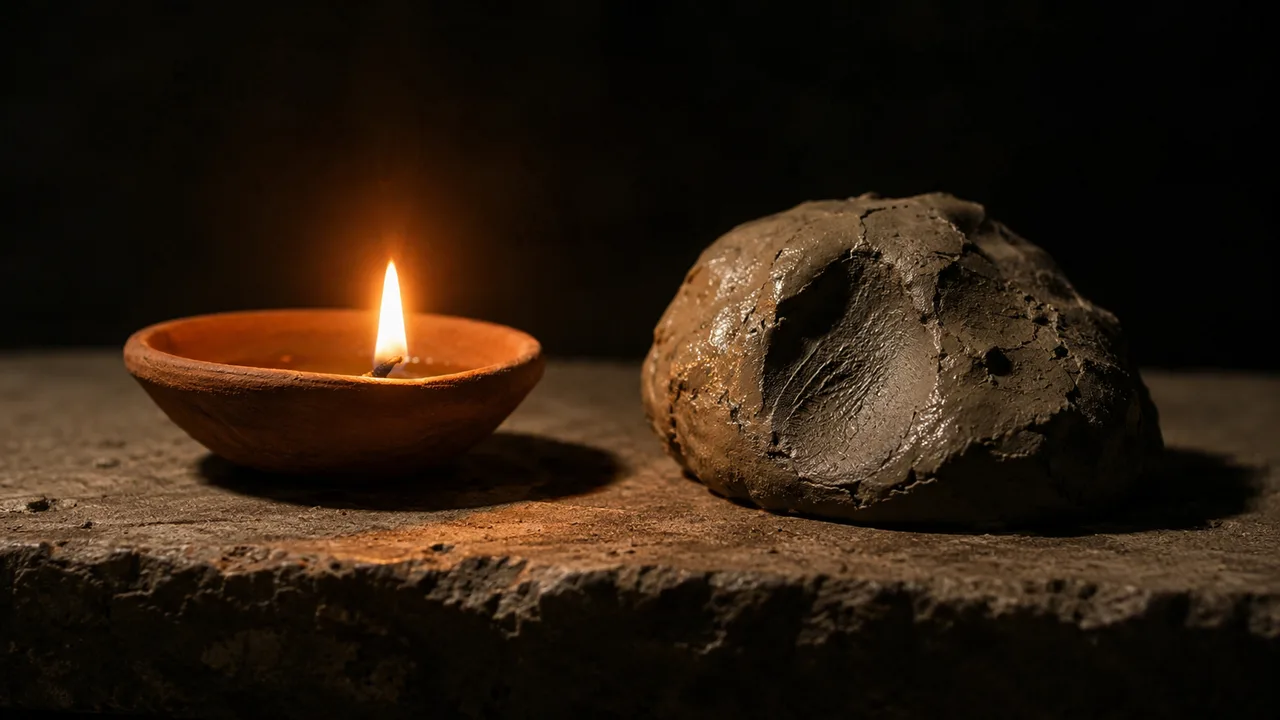
The Qur'an answers in five words, and the answer breaks the most famous image in religious history. Iblis was never an angel, and that changes his whole story.
Picture the most repeated image in religious history: a radiant angel, proudest of heaven, cast down in flames. It hangs in galleries, drives epic poems, and shapes how half the world imagines the devil. And according to the Qur'an, it is wrong on the first fact. Iblis was never an angel. When the command came to prostrate to Adam, the Qur'an tells you exactly what stood there refusing: "He was of the jinn and departed from the command of his Lord" (18:50). Five words settle the question this article's title asks. Shaytan is a jinn, a created being of smokeless fire with free will, and the difference is not trivia. It rewrites his crime, his sentence, and the exact shape of the war he is still running against you.
The Prophet ﷺ separated the three races in a single sentence: "The angels were created from light, the jinn from smokeless fire, and Adam from what was described to you." Three materials, three job descriptions. And the Qur'an describes the angels as beings who never disobey what Allah commands them. That is the load-bearing fact. An angel refusing a direct order is not a scandal; it is an impossibility, like water refusing to be wet.
So when one being in that gathering said no, the refusal itself was the species test. Whatever just disobeyed could not be an angel. The Qur'an confirms it was the jinn standing among them, present for the command because he was there in the assembly, but built from different material and, crucially, built with a choice.
Watch what he actually said when Allah asked him what prevented him. Not an apology. A theory. "I am better than him. You created me from fire and created him from clay" (7:12). The first sin committed in the story of our race was not murder or theft. It was arrogance dressed up as logic, a being looking at Allah's direct command and countering with his own reasoning about materials, as if chemistry outranked the Creator's word.
The earlier verse had already named the engine underneath: "He refused and was arrogant and became of the disbelievers" (2:34). Refusal, arrogance, disbelief, in that order. Sit with that sequence. It is the same staircase every soul walks down: first the no, then the justification, then the hardening.
What happens next reads like nothing else in scripture. The condemned being asks for something, and the request is granted. "Reprieve me until the Day they are resurrected," he said. "Indeed, you are of those reprieved" (7:14-15). Then he declared exactly what he would do with the time: "I will surely sit in wait for them on Your straight path. Then I will come to them from before them and from behind them and on their right and on their left, and You will not find most of them grateful" (7:16-17).
Read that like a threat assessment. He filed his entire battle plan in advance, in open court, and it was entered into the record for you to study. The ambush point is named: the straight path, not the crooked ones, because the people already lost need no ambush. The directions are named: in front of you, your future and your fears; behind you, your past and your regrets; your right and your left. And elsewhere he swore the oath that reveals his one blind spot: "By Your might, I will surely mislead them all, except, among them, Your chosen servants" (38:82-83). Even he knew there is a category of person he cannot touch.
The Qur'an records a speech Shaytan has not delivered yet. It happens after the judgment, when his followers turn on him, and it may be the most honest thing he ever says: "Indeed, Allah had promised you the promise of truth. And I promised you, but I betrayed you. But I had no authority over you except that I invited you, and you responded to me. So do not blame me; but blame yourselves" (14:22).
Read that line again: no authority, only an invitation. The being half the world imagines as a horned puppet-master will stand up in the end and testify that he never once forced a human hand. He whispered. We walked. Every scary story ever told about his power dissolves in his own closing statement.
So the answer is settled: a jinn, not a fallen angel. But notice what the correction does. If Iblis were a fallen angel, his story would be an exotic tragedy about a higher order of being, nothing to do with you. Because he is a jinn, a creature with free will facing a command he did not like, his story is a mirror. He heard an instruction, consulted his ego, and chose himself. That option sits in front of you every single day.
And one more thread runs through it: he refused to bow to your father out of contempt for what you are made of. Clay against fire. Every whisper since is the same argument continued by other means, an ancient courtroom claim that you were never worth the honor Allah gave you. Each time you resist the whisper and bow to your Lord anyway, you personally file the counter-evidence.
Silsila Research Desk
Grade: Sahih · 6 min read