
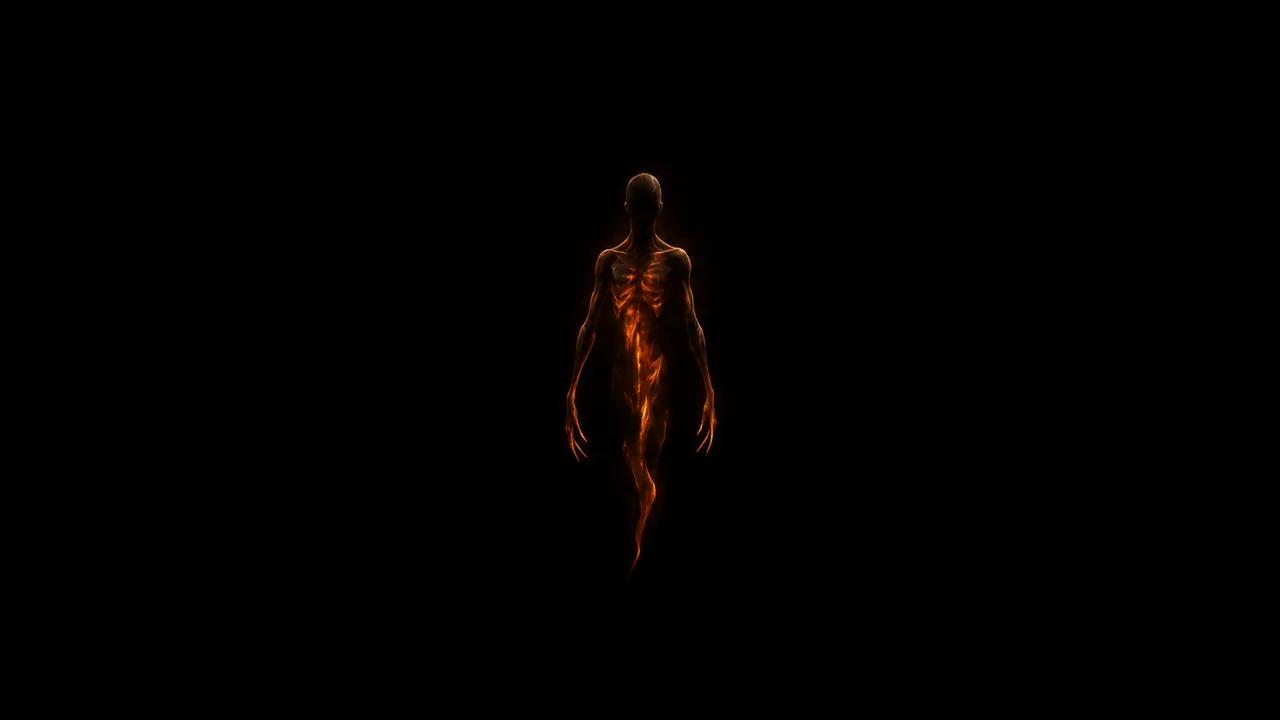
Made of smokeless fire, one assigned to every human being, and armed mainly with a whisper. The sourced picture, without the folklore.
There is one assigned to you. Not to humanity in general, to you, personally, since birth. The Prophet ﷺ said it without softening: "There is none amongst you with whom is not an attache from amongst the jinn." The companions, hearing this, asked the question you are asking now: even you, Messenger of Allah? "Yes," he said, "but Allah helps me against him... and he does not command me but for good." So who are these beings? A second created race, made from smokeless fire as we were made from clay, living unseen alongside us, choosing belief or rebellion exactly as we do, and armed, for all the terror stories, mainly with a whisper. That is the sourced picture. Hold onto it, because almost everything else you have heard about the jinn comes from folklore, and the truth is both less cinematic and more personal.
The Prophet ﷺ laid out the three creations in one sentence: "The angels were created from light, the jinn from smokeless fire, and Adam from what was described to you." The Qur'an gives the jinn their element in almost the same words: "He created the jinn from a smokeless flame of fire" (55:15).
Fire, not evil. The material is not the verdict. Angels cannot disobey; we and the jinn can, and that shared free will is the real kinship between our races. The Qur'an states the shared job description too: "I did not create the jinn and mankind except to worship Me" (51:56). Two races, one exam.
Because they choose, they divide. An entire surah opens with a group of jinn stumbling onto the Qur'an being recited: "It has been revealed to me that a group of the jinn listened and said: Indeed, we have heard an amazing Qur'an. It guides to the right course, and we have believed in it, and we will never associate with our Lord anyone" (72:1-2). There are muslim jinn. There are righteous jinn. There are jinn who found their Lord by overhearing recitation, and left that valley with their eternity rewritten.
And there is the other kind, with one infamous name at their head. When the angels were commanded to prostrate to Adam, one being in the gathering refused, and the Qur'an is precise about his species: "He was of the jinn and departed from the command of his Lord" (18:50). Iblis was not a fallen angel. Angels cannot fall. He was a jinn who chose, and the verse ends with a warning shaped like a question: will you take him and his descendants as allies, when they are enemies to you?
Now the practical question. What is this hidden race actually able to do to you? The Prophet's ﷺ answer names a channel, not a weapon: "Satan reaches everywhere in the human body as blood reaches in it." He said this after walking his wife Safiyya home one night, when two companions passed by, and he called out to tell them she was his wife. He explained that he feared shaytan might drop a thought into their hearts. Read that scene carefully. The threat he took seriously was not levitation or terror in the night. It was a single planted thought in the minds of two righteous men.
That is the jinn's real arsenal: the whisper, the suggestion, the thought that arrives wearing your own voice. Your qarin does not need to throw furniture. He needs one idea at the right moment, the flash of resentment, the convenient justification, the despair at 2am.
The Qur'an records what happens when humans hand the jinn power over them: "There were men from mankind who sought refuge in men from the jinn, so they only increased them in burden" (72:6). The pre-Islamic Arabs crossing a valley at night would call out for the protection of its jinn, and the seeking itself fed the darkness. Every amulet bought, every fortune-teller consulted, every fear-driven ritual is the same transaction: paying protection money to a creature whose only real currency is your fear.
And the defence? The Qur'an gives it as a du'a of two lines: "My Lord, I seek refuge in You from the incitements of the devils, and I seek refuge in You, my Lord, lest they be present with me" (23:97-98). No ritual, no specialist, no fee. The being made of fire retreats from a sentence spoken by the being made of clay, because the sentence goes over his head, to the One who owns them both.
Come back, at the end, to your attache. He has been at the assignment your whole life. He knows which sins you rationalise most fluently and which wounds open with one word. And the Prophet's ﷺ hadith about him carries a strange comfort: even the best of creation ﷺ had one, so the whispering you hear is not a sign that you are broken. It is a sign that you are human, mid-exam, exactly where every believer before you has stood.
You cannot fire him. You can bankrupt him. Every whisper refused weakens the next one, every remembrance of Allah empties the room he works in. Two races were created to worship; make sure that in your corner of the unseen, the one made of clay is the one setting the tone.
Silsila Research Desk
Grade: Sahih · 6 min read