
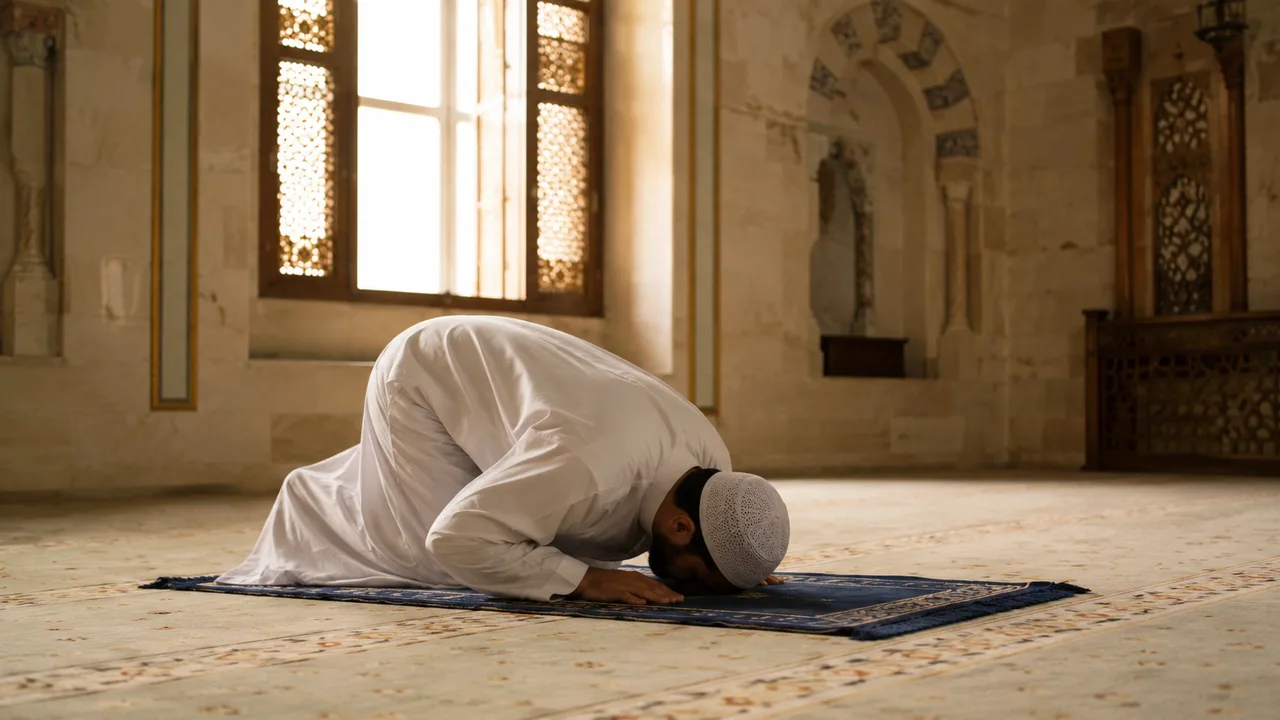
Your prayer is the first of your own deeds to be judged. Bloodshed is the first case settled between people. Then five questions your feet cannot move past.
You are standing in a crowd with no edges, and your feet will not move. Not one step. Not until the questions are answered. That is how the Prophet Muhammad ﷺ described the moment, and it is worth knowing now what those questions are, because they are not a secret and they were never meant to be one. Of everything you ever did, the first deed brought forward is the prayer. Of everything that ever passed between you and another human being, the first case opened is the taking of a life. And before your feet are released, five things are put to you: your life and how you spent it, your knowledge and what you did with it, your wealth, both where it came from and where it went, and your body and what you wore it out doing.
Abu Hurayrah (RA) narrated it to a man who asked him for something he heard from the Messenger of Allah ﷺ, in the hope that Allah lets me benefit from it.
What Abu Hurayrah (RA) gave him was this. The first deed a servant is called to account for on the Day of Resurrection is his prayer. If it is complete, he has succeeded and is saved. If it is defective, he has failed and lost. Then, if something is missing from his obligatory prayers, the Lord says, look, does My servant have any voluntary prayers, and the shortfall is filled in from those. Then the rest of his deeds are handled the same way (Jami at-Tirmidhi 413, and Sunan an-Nasa'i 465).
Read the last sentence again, because it is the part people skip. The prayer is not just first in the queue. It sets the method. Whatever the reckoning finds missing gets checked against what you gave beyond the minimum. That is a mercy with a hard edge in it. It only helps a person who built a habit of giving more than was demanded, in the years when nobody was watching and there was no emergency to make him do it.
The other narration is short enough to sting. Abdullah ibn Mas'ud (RA) reported that the Prophet ﷺ said the first cases decided among people on the Day of Resurrection will be the cases of bloodshed (Sahih al-Bukhari 6533, Sahih Muslim 1678a).
Not theft. Not slander. Not broken contracts, though all of those are answered for. Blood goes first. Before any other claim one person holds against another is even opened, the court begins with the lives that were taken.
People hit these two narrations and assume one must be wrong. Look at how each one is worded. The prayer narration says the first deed a servant is called to account for. That is your file, the one that concerns what you owed Allah directly. The bloodshed narration says the first thing decided among people. That is a different docket entirely, the claims human beings hold against each other, and the first item on it is a life.
So there are two lines forming, not one. In the first, you stand alone and your prayer is opened. In the second, someone stands opposite you, and if there is blood between you, that is settled before anything else you two ever did to each other.
Abu Barzah al-Aslami (RA) narrated that the Prophet ﷺ said the feet of a servant will not move on the Day of Judgment until he is asked about five things. His life, and what he did with it. His knowledge, and what he did with it. His wealth, how he earned it, and where he spent it. His body, and what he wore it out doing (Jami at-Tirmidhi 2417).
Notice that wealth is asked about twice. Where it came from is a separate question from where it went. A person can give generously from money that was never clean, and both halves of that get read out. Notice too that knowledge is not asked about as a quantity. Nobody is asked how much he knew. He is asked what he did with it, which is a much worse question for anyone who learned something and then lived as though he had not.
And the body. You get one, it gets spent on something, and that question has an answer already forming in whatever you did today.
The Quran adds a question that catches people off guard, because it is not about sin at all. Competition in worldly increase diverts you, until you visit the graveyards (102:1 to 2). The surah runs through the whole arc of a distracted life, and then lands here. Then you will surely be asked that Day about pleasure (102:8).
There is a night that shows exactly how heavy this is. Abu Hurayrah (RA) reported that the Prophet ﷺ went out of his house, and found Abu Bakr (RA) and Umar (RA) already out. He found they had come out for the same reason he had, hunger. The three of them went to the house of a man from the Ansar, who welcomed them, brought out dates, slaughtered a sheep, and gave them water. When they had eaten and drunk their fill, the Prophet ﷺ said to Abu Bakr (RA) and Umar (RA), by Him in whose hand is my life, you will certainly be questioned about this bounty on the Day of Judgment. Hunger brought you out of your house, and you did not return until this came to you (Sahih Muslim 2038a).
Sit with that. Three men who had been walking the streets hungry an hour earlier ate dates and meat and cold water, and were told that meal would be asked about. Ma'arif al-Qur'an, commenting on 102:8, records Mujahid saying the question covers every delight a person enjoyed, food, clothing, a house, a spouse, children, office, honour, and Qurtubi's point that this is right precisely because the verse does not name one blessing over another. Al-Sa'di reads the verse as asking whether you thanked Allah for what He gave you and gave Him His right in it, or were deceived by it.
Do not pursue that of which you have no knowledge. Indeed, the hearing, the sight and the heart, about all those one will be questioned (17:36). Ma'arif al-Qur'an ties this verse directly to the question about blessings, and the connection is uncomfortable in the right way. The ear and the eye and the heart are three doors that take in more of your life than anything else you own, and they are the three named. What you listened to. What you looked at. What you let settle in your chest and stay there.
And nothing is too small to reach the record. We place the scales of justice for the Day of Resurrection, so no soul will be treated unjustly at all. And if there is even the weight of a mustard seed, We will bring it forth. And sufficient are We as accountant (21:47).
The Quran gives one scene where the failures state their own reasons without being told. The people of the garden ask the criminals what put them into the Fire, and they answer for themselves. We were not of those who prayed, nor did we used to feed the poor, and we used to enter into vain discourse with those who engaged in it, and we used to deny the Day of Recompense (74:42 to 46).
Look at what came out of their mouths first. Not the great crimes. The prayer.
You already have the paper before the exam. Nobody sits this one blind. So take the first question seriously, the one about the prayer you either prayed today or did not, because everything after it gets weighed the same way.
Silsila Research Desk
Grade: Sahih · 7 min read