
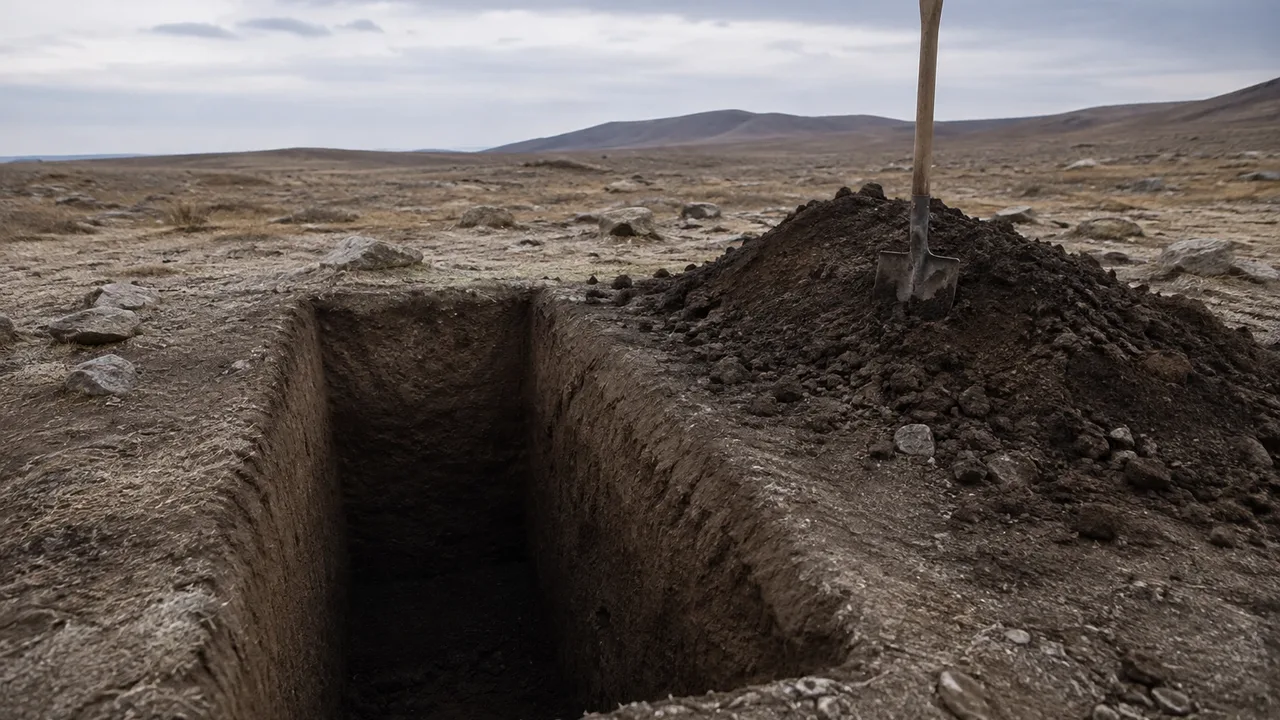
The first night of the next world. Two angels, three questions, and a grave that widens into a garden or closes in like a fist.
First there is the sound of the shovel. Then the weight of the earth. Then, worst of all, the footsteps. The people who loved you, walking back to their cars, back to dinner, back to their lives, while you stay. You are alone in the dark for the first time in your existence. Except you are not. Two angels are already there, and they have three questions: Who is your Lord? What is your religion? Who is this man who was sent among you? What happens next depends entirely on how you lived, because the grave opens into a garden or closes like a fist, and there is no third door. This is the barzakh, the world between the worlds, and every one of us has an appointment there.
We spend our whole lives not thinking about this. We bury our parents and grandparents and somehow still file death under things that happen to other people. The Qur'an refuses us that comfort. "Every soul will taste death. Then to Us will you be returned" (29:57). And it does not pretend the tasting is sweet. "And the intoxication of death will bring the truth. That is what you were trying to avoid" (50:19).
That is what you were trying to avoid. Read that line again and feel how personally it is aimed.
But here is the first mercy, and the first terror. Even the arrival of death does not look the same for everyone.
The Prophet ﷺ described it in one long, unforgettable narration. When a righteous soul is about to leave the world, angels come down with faces bright as the sun, carrying a shroud of Paradise and perfume of Paradise. The soul is called out with tenderness, "O good soul, come out to the forgiveness and pleasure of your Lord," and it slips free easily, and the angels wrap it in that fragrance and carry it up, and every rank of heaven asks, who is this beautiful soul? His record is written among the righteous, and he is returned to his body for what comes next.
And the sinner? The same narration does not look away, and neither should we. Angels come to him with black faces, carrying rough sackcloth. His soul hears, "O evil soul, come forth to the wrath of Allah and His anger," and it is dragged out of him the way a skewer is pulled through wet wool. The same moment, the same room, maybe even the same hospital bed, and two completely different receptions. The angels do not decide which welcome you get. Your years already did.
For the steadfast, the Qur'an makes the promise out loud: "Indeed, those who have said, 'Our Lord is Allah' and then remained on a right course, the angels will descend upon them, saying, 'Do not fear and do not grieve but receive good tidings of Paradise, which you were promised'" (41:30).
At the funeral, three companions walk behind you, and the Prophet ﷺ counted them. "The dead person is followed by three: his family, his wealth, and his deeds. His family and his wealth turn back, and his deeds remain with him."
Sit with that. The people who cried hardest at your graveside go home and eat dinner. The money you guarded your whole life is already someone else's. The only thing that climbs down into the dark with you is the one thing most of us spend the least time on. Your deeds are the children you raised without ever seeing their faces, and the grave is where you finally meet them.
Then the crowd thins, the last du'a is said, and the last of them walks away for good. The silence that settles is the first silence of the next world.
The two angels who come are not gentle interviewers. One narration names them Munkar and Nakir and describes them as dark and severe, the kind of presence that fills a small space. They sit you up and the exam begins. Who is your Lord? What is your religion? Who is this man who was sent among you?
Notice what the questions are not. They are not trick questions. They are not obscure. A child in a Friday school could recite the answers. But the grave does not accept recitation. You can only say who your Lord is if you spent your life turning to Him. You can only name your religion if you actually lived inside it. You can only testify about the Messenger ﷺ if you followed him when following him cost you something. In the grave the tongue answers from the heart's savings account, and no one can lend you anything at that hour.
This is exactly the scene the Qur'an had in mind. When the believer answers cleanly, it is the fulfilment of a promise: "Allah keeps firm those who believe, with the firm word, in worldly life and in the Hereafter" (14:27). The Prophet ﷺ taught that this verse came down about the questioning of the grave. The steadiness in that moment is not luck and it is not nerves of steel. It is the same firm word, held for decades, holding you back.
When the believer answers, heaven itself responds. A caller announces, "My servant has spoken the truth, so spread for him a bed from Paradise, clothe him from Paradise, and open for him a door to Paradise." Warmth and fragrance pour in. His grave is pushed wide, as far as his eye can see.
And then comes my favourite detail in all of it. A man appears in the grave, handsome, smelling of something wonderful, and the believer, overwhelmed, asks who he is. The answer: "I am your righteous deeds." Every prayer you dragged yourself to. Every coin you gave when money was tight. Every time you held your tongue. All of it, gathered into a face that has come to keep you company until the Hour. One narration paints the deeds standing guard around him, his prayer at his head, his fasting and his charity at his sides, each one blocking the punishment from its own direction. What you built in secret arrives in the dark as an army.
And the one who could only say, I do not know, I do not know? The caller announces his lie. A bed is spread for him from the Fire and a door to the Fire is opened, and its heat finds him. The grave squeezes until his ribs interlock. A blow lands on him that everything in creation hears except men and jinn. A figure comes to sit with him too, foul-faced, foul-smelling, and when the terrified soul asks who he is, the answer is the same sentence turned inside out: "I am your evil deeds." One narration even describes serpents set upon him in that darkness. And he begs, "My Lord, do not establish the Hour," because for him, worse is coming.
Do not assume this is only for tyrants and murderers. The Prophet ﷺ once passed two graves and said their occupants were being punished, one because he was careless about drops of his own urine, the other because he walked between people carrying tales. Habits you would barely put on a list of sins. In the ground, nothing is small.
While the barzakh lasts, every soul is shown the same view twice a day. "When anyone of you dies, he is shown his place both in the morning and in the evening," the Prophet ﷺ said. The people of Paradise watch their seat in Paradise. The people of the Fire watch theirs. Imagine a window you cannot close, opening every dawn and every dusk onto your own eternal address. For one soul it is the sweetest appointment of the day. For the other it is the alarm clock of dread. The Prophet ﷺ called the grave the first stage of the Hereafter, and said that whoever passes it, everything after is easier.
The Prophet ﷺ himself, forgiven and promised the highest station, still used to plead, "I seek refuge in You from the punishment of the grave, from the punishment of the Fire, from the trials of life and death, and from the evil of the trial of the Dajjal." Look at the company the grave keeps in that du'a. He placed it in the same breath as the greatest deception the world will ever see. He took it that seriously, and he had the least to fear from it of anyone who ever lived.
So take the honest ending with you. The grave is the only exam in existence where the questions are handed out before the test. Who is your Lord? What is your religion? Who is your Prophet? You are holding the answers right now, in daylight, with time on the clock and a heart still beating. The whole art of dying well turns out to be nothing more mysterious than living as if the answers were true. Start tonight. The footsteps, one day, will be walking away from you.
Silsila Research Desk
Grade: Sahih · 7 min read