
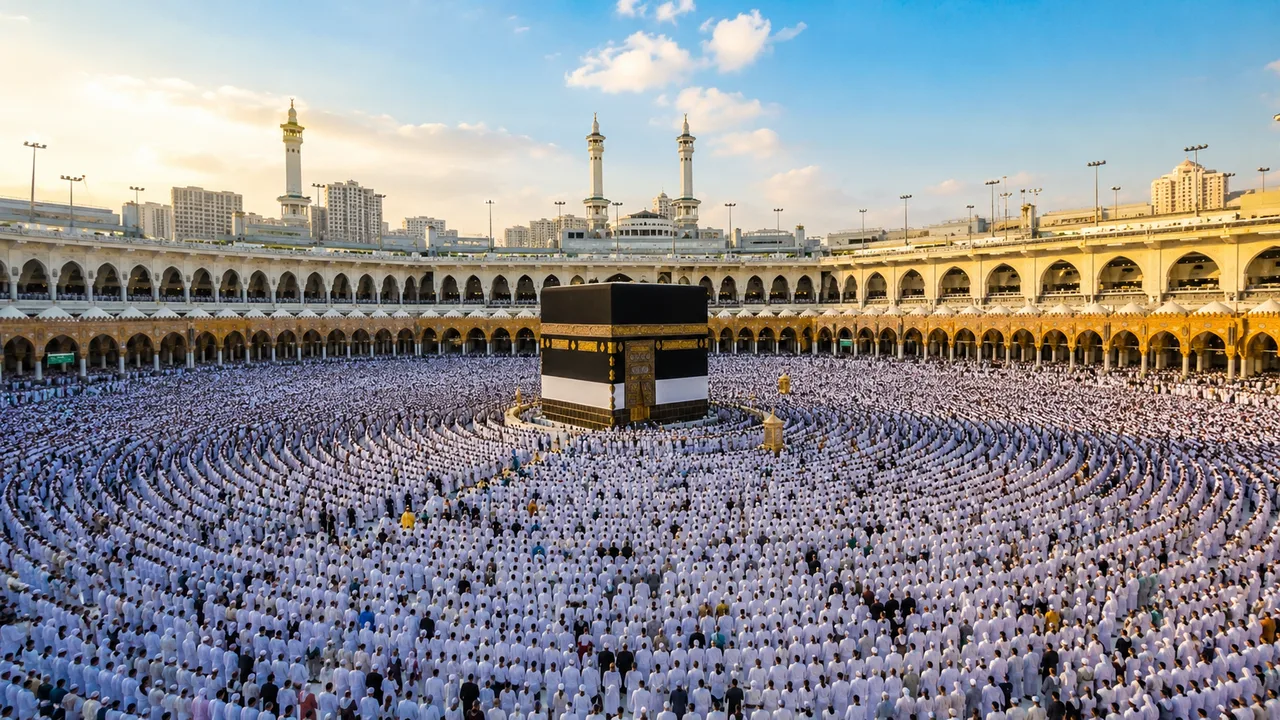
Two million people in identical white cloth, circling one stone house. Why does Allah call every able believer to walk there once?
Two million people, dressed in the same two pieces of unsewn white cloth, walk in a circle around a plain stone building seven times, in a desert city, saying words their grandparents said, and their grandparents' grandparents. No thrones in that crowd. No first names, no titles, no queue for the wealthy. A minister and a street sweeper press shoulder to shoulder toward the same corner of the same building. This is Hajj. It is not a holiday and it is not optional sightseeing. It is a duty Allah placed on every believer who can physically make the journey and afford it, owed once in a lifetime, and it has looked almost exactly like this for fourteen centuries.
The Quran states the obligation without softening it. "And due to Allah from the people is a pilgrimage to the House, for whoever is able to find thereto a way" (3:97). Once, not every year. Only if the road is genuinely open to you, in body and in means. Skip it by choice when you could have gone, and the verse does not flatter you for it; it says plainly that Allah has no need of anyone's excuses.
To understand why the pilgrimage exists at all, go back before the crowds, before the city, to a valley with no water and no house. Ibrahim (AS) was told by Allah, "Do not associate anything with Me and purify My House for those who perform tawaf and those who stand in prayer and those who bow and prostrate" (22:26). He and his son Ismail (AS) raised the walls themselves, stone by stone, praying as they worked rather than boasting over it: "Our Lord, accept this from us. Indeed, You are the Hearing, the Knowing" (2:127). Ibrahim (AS) then asked Allah to make the place secure and to feed the people who would settle there (2:126), and Allah answered him with an instruction that reaches every mosque and every believer's heart today: "Take, from the standing place of Abraham, a place of prayer" (2:125).
Then came the part that turned one family's labor into a permanent gathering of nations. Allah told Ibrahim (AS), "And proclaim to the people the hajj; they will come to you on foot and on every lean camel; they will come from every distant pass" (22:27). A man with no radio, no roads, and no way to reach beyond his own voice was told to summon the whole earth to an empty valley, and the summons worked. It still works. The crowds walking around that same House today, however they arrived, are the promise in that verse still being kept.
Hajj is not one action; it is a sequence, and each step carries the whole story forward. A pilgrim enters ihram, a state of humility marked by that plain white cloth, before crossing into the sacred area. Inside Mecca, tawaf comes first: circling the Kaaba seven times, the same act Ibrahim (AS) and Ismail (AS) were told to keep the House clean for. Then sa'i, walking briskly between the hills of Safa and Marwah, of which the Quran says, "Indeed, as-Safa and al-Marwah are among the symbols of Allah. So whoever makes hajj to the House or performs umrah, there is no blame upon him for walking between them" (2:158). Accounts describe this rite as tracing Hajar's search for water for her infant son, back and forth across the same ground, until Allah answered her.
From there the pilgrim stands at Arafah, a wide plain outside the city, for the single afternoon scholars call the heart of Hajj. Then Muzdalifah for the night, then Mina for the stoning of the pillars and the sacrifice, echoing Ibrahim's (AS) own trial with his son. Allah describes the purpose plainly: "That they may witness benefits for themselves and mention the name of Allah on known days over what He has provided for them of sacrificial animals. So eat of them and feed the miserable and poor" (22:28), before the final instruction, "Then let them end their untidiness and fulfill their vows and perform tawaf around the ancient House" (22:29). Through all of it, the Quran sets the tone: "there is to be for him no sexual relations and no disobedience and no disputing during hajj," and the traveler is told to pack for the road but to remember "the best provision is fear of Allah" (2:197).
The clearest picture of how these rites are meant to be performed does not come from a manual. It comes from watching the Prophet Muhammad ﷺ do it once, near the very end of his life. On the Day of Sacrifice, during what history remembers as his Farewell Hajj, he was seen throwing pebbles at the pillar while riding his camel, and he said to the people gathered around him, "Learn your rites, for I do not know whether I will perform hajj after this hajj of mine" (Sahih Muslim 1297). He was right. Within months he had passed away. That single sentence, spoken almost in passing on a hillside outside Mecca, is why the rites performed by pilgrims today still trace his own footsteps rather than anyone's guess at them.
Strip away the crowds and the logistics and what is left is a father who built a house for people he would never meet, and a Lord who told him to call them anyway. Every pilgrim circling that House today, in the same plain cloth, saying the same words, is answering a summons that went out before airports, before nations, before most of what divides people from each other. The Quran completes it and the sacred months hold it and the Prophet ﷺ showed exactly how to walk it, once, so that no one after him would have to guess. That is what Hajj is. Not a trip. A debt of the body and the heart, owed once, to the House that was raised for exactly this.
Silsila Research Desk
Grade: Sahih · 7 min read