
For over a year the Prophet ﷺ prayed toward Jerusalem, silently longing. Then a verse turned the entire planet's prayer to please one man's heart.
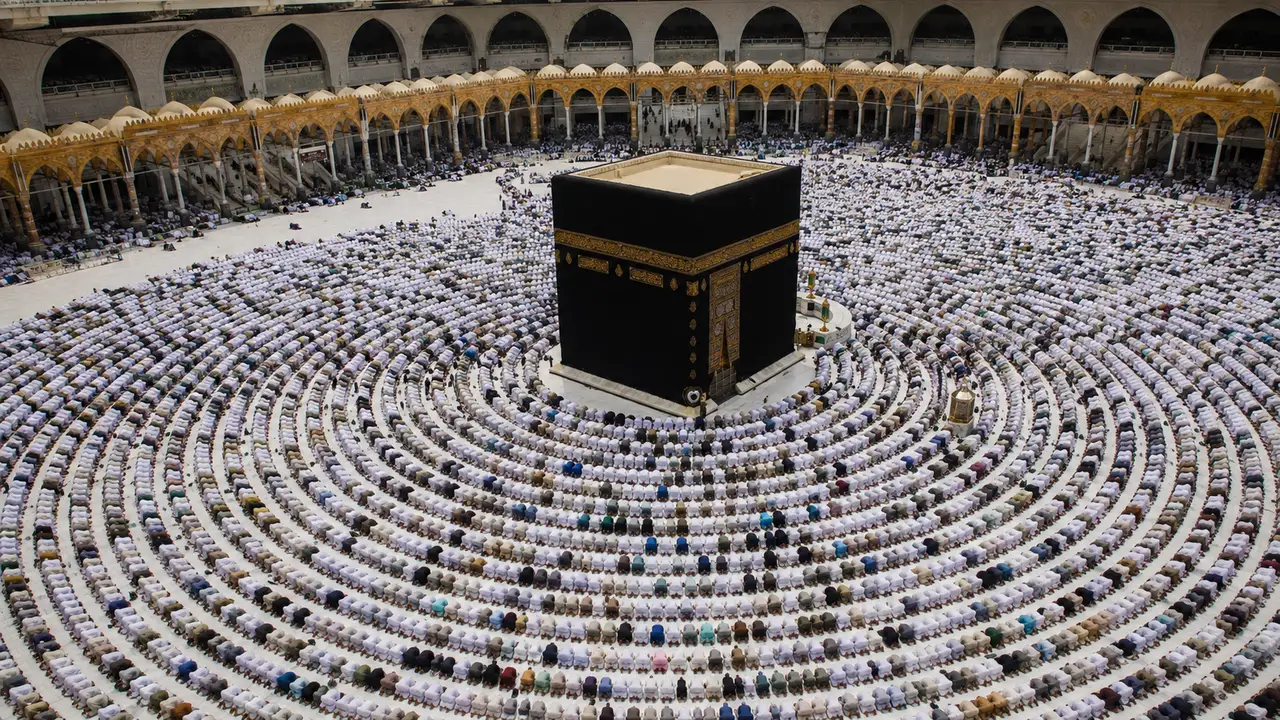
Right now, as you read this, somewhere on earth a line of people is bowing toward a stone building in Makkah. In Jakarta they face west. In New York they face roughly northeast. In Cape Town, north. Two billion people, arranged on a sphere, all oriented toward a single cube of grey stone, five times a day, every day. Ask the obvious question, do Muslims worship that building? and the answer is a flat no. The Kaaba is empty. So why does every prayer on the planet point at it? The story behind the answer involves a secret longing, a mid-prayer U-turn, and one of the most tender verses in the Quran.
Here is what surprises most people: Muslims did not always face the Kaaba. After the migration to Madinah, the Prophet Muhammad ﷺ and the believers prayed toward Bayt al-Maqdis in Jerusalem for sixteen or seventeen months. And through those months, something was building in the Prophet's ﷺ chest. He loved the Kaaba, the House raised by his forefather Ibrahim (AS), the House Allah had made "a place of return for the people and security" (2:125). He would turn his face toward the sky, again and again, hoping, and asking for nothing out loud.
The Quran records that silent habit with startling intimacy: "We have certainly seen the turning of your face toward the heaven, and We will surely turn you to a qiblah with which you will be pleased" (2:144). Read what actually happened there. He never voiced the request. Allah watched the upturned face, understood the unspoken wish, and rewrote the orientation of all human worship to please him: "So turn your face toward al-Masjid al-Haram. And wherever you believers are, turn your faces toward it" (2:144). Scholars of tafsir have long marvelled at this verse: the direction of every prayer until the end of time was set, in part, as a gift to one beloved heart.
The command reached the people of Quba, on the edge of Madinah, while they were actually praying. A man arrived with the news: revelation has come down, the qibla is now the Kaaba. And the congregation, mid-prayer, rotated where they stood, the whole assembly wheeling around to face the opposite direction without breaking the prayer.
That image is the whole religion in a single motion. They did not finish the prayer and discuss it. They did not ask for the verse's reference. Command arrived, bodies turned. Fourteen centuries later, that pivot in a village mosque is still cited as the gold standard of what hearing and obeying looks like.
Why was there a first qibla at all, if the Kaaba was always beloved? The Quran answers directly: "And We did not make the qiblah which you used to face except that We might make evident who would follow the Messenger from who would turn back on his heels" (2:143). The direction was a filter. Anyone attached to their own preferences would stumble at a command that changed; anyone attached to Allah would turn as easily as the people of Quba. The verse admits the difficulty, "indeed, it is difficult except for those whom Allah has guided", and then closes with a mercy for everyone who had prayed toward Jerusalem and wondered if those prayers were wasted: "never would Allah have caused you to lose your faith" (2:143). Not one prostration was lost. Allah does not delete sincere worship over a technicality of geography.
Meanwhile the critics sneered, and the Quran pre-recorded their sneer: "The foolish among the people will say: what has turned them away from their qiblah which they used to face?" (2:142). The reply given to the Prophet ﷺ dismantles the whole objection in one line: "Say: to Allah belongs the east and the west" (2:142). No direction is holy by itself. East and west are His. A qibla is wherever He points.
Because prayer is the most repeated act in a Muslim's life, and Allah chose to weld it to unity. "And from wherever you go out, turn your face toward al-Masjid al-Haram. And wherever you may be, turn your faces toward it" (2:150). One direction means the ummah prays as a single body. Zoom out far enough and the picture assembles itself: rings of worshippers around the Kaaba in Makkah, then rings of mosques around the city, then rings of countries, the entire planet arranged in concentric circles of prostration around the House of Ibrahim (AS). No headquarters designed it. A verse did.
And the direction disciplines the worshipper, not Allah. He is not in the Kaaba, He is not confined to any direction, and the building itself has been rebuilt multiple times in history while the prayers continued uninterrupted. The Kaaba is a meeting point for foreheads, the fixed pin that keeps two billion scattered compasses honest.
That emptiness is the final answer to the question. Civilisations have always faced their thrones, their idols, their capitals. Muslims face a cube that contains nothing. It is perhaps the loudest architectural statement ever made: we are all facing the same way, and the One we are facing is not inside the box. He is the Owner of the east and the west, and He chose this House, built by Ibrahim (AS) and honoured by Muhammad ﷺ, as the place where all our directions agree.
So why do Muslims face the Kaaba? Because Allah commanded it, because the command unified a planet, and because buried inside the legislation is one of the most human moments in the Quran: a man turning his face to the sky, wanting something too much to ask for it, and the Lord of the worlds answering the wish before it was spoken.
Silsila Research Desk
Grade: Sahih · 6 min read