
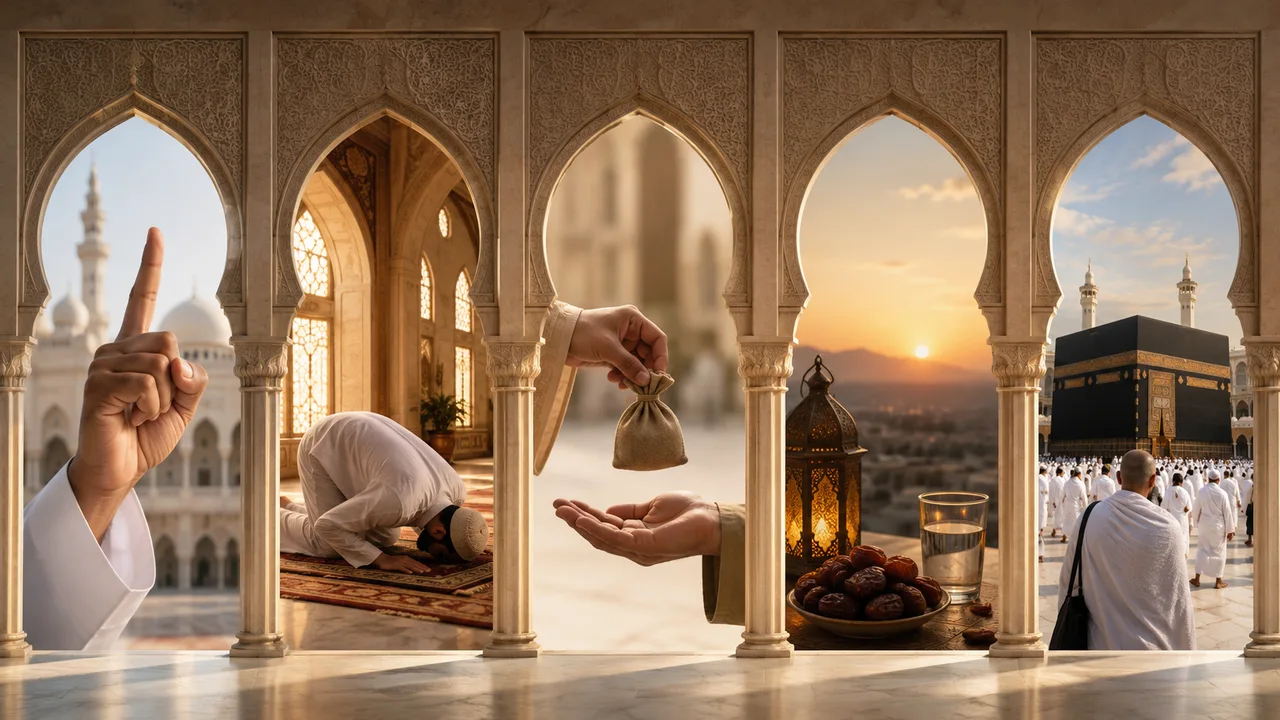
The Prophet ﷺ named five acts that hold up the entire religion. Testimony, prayer, charity, fasting, pilgrimage, sourced one by one.
Picture a tent held up by five wooden poles. Pull one out, and the whole canopy sags. That is the image the Prophet ﷺ reached for himself, when a companion asked him what actually holds this religion together. Islam, he said, is built on five: bearing witness that there is no god but Allah and that Muhammad ﷺ is His messenger, establishing the prayer, paying the zakah, fasting Ramadan, and making the pilgrimage to the House for those who are able. Five acts. Not five suggestions to rotate through as it suits you. Five poles, and the tent only stands when all of them are in the ground.
Ibn Umar narrated this from the Prophet ﷺ directly, and both Bukhari and Muslim carried it in their collections. It is one of the shortest hadith in the entire canon and one of the most repeated, because it is the floor plan of the whole religion, handed over in a single breath.
Before a single prayer is made or a single fast is kept, there is a sentence. Every convert says it first. Every child raised Muslim hears it before anything else. It is the pole the other four lean on. La ilaha illallah, Muhammad rasulullah. There is no god but Allah, and Muhammad ﷺ is His messenger. The Quran puts the full weight of witnesses behind this one claim. "Allah witnesses that there is no deity except Him, and so do the angels and those of knowledge, maintaining creation in justice. There is no deity except Him, the Exalted in Might, the Wise" (3:18). Read that line again. Allah is named first as witness to His own oneness, then the angels, then everyone who actually knows what they are talking about. This is not a slogan people repeat out of habit. It is the claim every other pillar rests on. Prayer without this sentence behind it is motion. Charity without it is generosity aimed nowhere in particular. Get this pole wrong, and nothing else in the tent stands straight.
Then comes the pole you can watch a person perform. Salah, prayer, five times inside every twenty four hours, at fixed times that do not wait for anyone's convenience. "And establish prayer and give zakah, and bow with those who bow" (2:43). Notice how the Quran keeps stitching prayer and charity into the same sentence, as if performing one without the other only tells half the story. Salah is the pole a person cannot hide behind excuses for very long. It interrupts the workday. It interrupts sleep before dawn. It asks someone to stop whatever they are building, stand facing one direction, and do it five separate times, every single day of their life. That repetition is the whole point. A person does not decide once to be devoted. He decides again at fajr, again at midday, again as the sun goes down, for as long as he is breathing.
Zakah is the pillar that leaves a person's own house and lands on a stranger's table. It is not a suggestion to be generous whenever it feels convenient. The Quran makes it an obligation with a defined shape. "Take from their wealth a charity by which you purify them and cause them increase, and invoke Allah's blessings upon them. Indeed, your invocations are reassurance for them" (9:103). And it names exactly who is meant to receive it: "the poor and the needy... and the stranded traveler, an obligation imposed by Allah" (9:60). Sit with that phrase. An obligation imposed by Allah. Not charity as a personality trait, something a generous person happens to feel like doing. A claim on wealth that the wealthy do not get to opt out of, aimed specifically at the person with nothing and the traveler stranded far from home with no way to reach his own money. Islam does not trust generosity to arrive on its own. It legislates it.
Sawm asks for something stranger. A whole month of choosing hunger and thirst on purpose, from before sunrise until after sunset, while food sits untouched in the same kitchen. "O you who have believed, decreed upon you is fasting as it was decreed upon those before you, that you may become righteous" (2:183). The reason is stated plainly. Not weight loss. Not tradition kept for its own sake. Taqwa, a kind of God consciousness that only shows up when the easy option, the glass of water three feet away, gets refused on principle, hour after hour. And then the Quran turns gentle about it. "Allah intends for you ease and does not intend for you hardship" (2:185). The sick and the traveling are let off the day and asked to make it up later, when it is easier to carry. This is not a religion trying to break the people who follow it. It is asking them to prove, once a year, for thirty days straight, that they can want something and still say no to it.
Hajj is the pillar with a deadline built into a lifetime rather than a day. Once, and only if a person can afford it and his body can carry him there. "Due to Allah from the people is a pilgrimage to the House, for whoever is able to find thereto a way. But whoever disbelieves, then indeed Allah is free from need of the worlds" (3:97). Millions converge on the same handful of acres every year, wearing the same two plain white cloths, so that a company director and a day laborer cannot be told apart in the crowd. They walk where Ibrahim (AS) once stood. The pillar is deliberately capped at once in a lifetime, and deliberately limited to those who can actually afford it, so it never becomes the obligation that breaks a poor household to fund a rich man's spiritual resume.
Take any one of the five out, and something in the whole structure gives. Say the words without ever standing in prayer, and the sentence stays vocabulary. Pray without the honesty of the shahada behind it, and the motion stays empty. Keep the prayer and the fast, but never let the zakah reach a stranger's table, and generosity stays a private feeling instead of a lived obligation. That is why the Prophet ﷺ reached for the image he did. Not five separate assignments to check off in whatever order suits a person. Five poles, load bearing, holding up one tent, meant to be lived standing all at the same time.
Silsila Research Desk
Grade: Sahih · 7 min read