
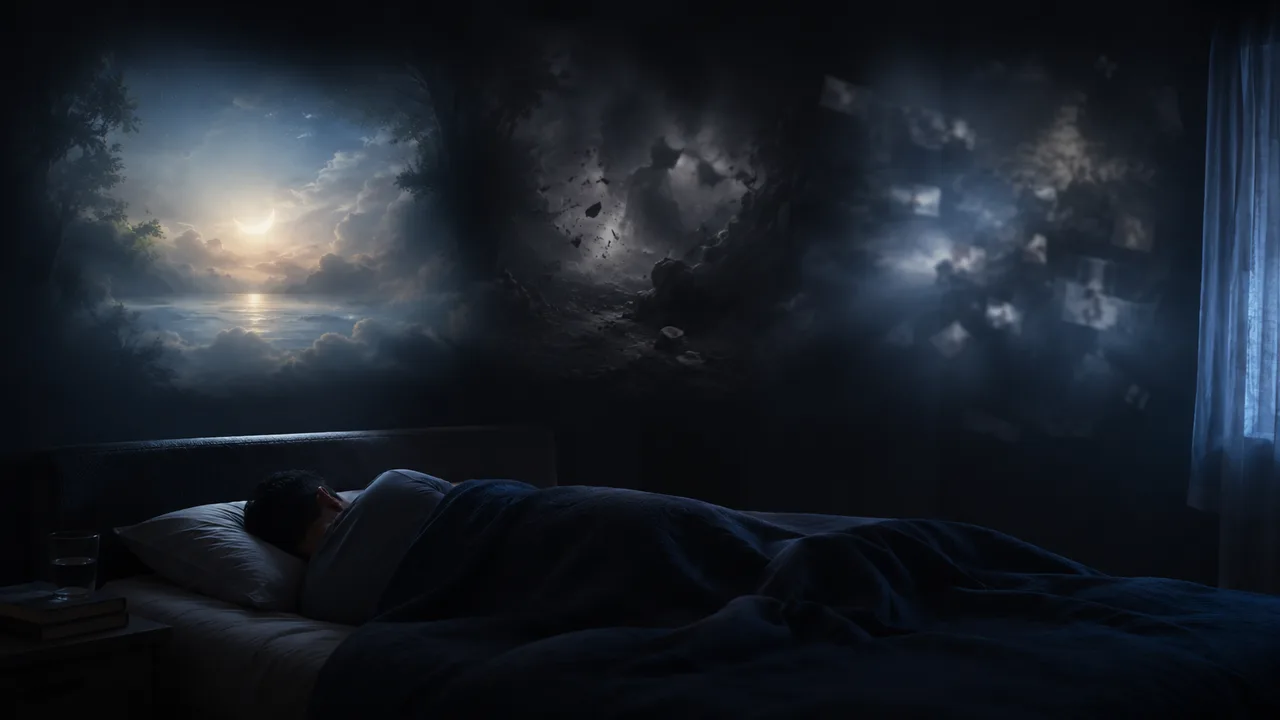
Not everything you see at night is noise. Islam sorts dreams by sender into three types, and gives an exact protocol for each, including the nightmare one.
You spend roughly a third of your life asleep, and some of those hours are filled with experiences vivid enough to wake you sweating or smiling. Every civilisation has argued about what those experiences are. Random brain noise, says one camp. Secret messages, says another. Islam's answer is more precise than both: your dreams are a sorted inbox with three possible senders, and the Prophet Muhammad ﷺ left an exact protocol for handling mail from each one.
The Prophet ﷺ classified dreams into three kinds. There is the good dream, which is from Allah. There is the bad dream, which is from Shaytan. And there is the dream that is simply your own self talking, the day's residue replaying, the anxieties of the afternoon wearing costumes at night.
That classification does two things at once. It saves the believer from superstition, because most dreams are just the third kind, the self's chatter, and require no interpretation, no worry, no meaning-hunting. And it saves the believer from cynicism, because not everything in the night is noise. Some of it is signal, and the tradition takes the signal deadly seriously: the Prophet ﷺ said nothing is left of prophethood except the mubashshirat, and when asked what those were, he answered: the righteous dream. Revelation has ended; a whisper of its light remains, scattered into the sleep of ordinary believers. Another narration counts the truthful dream as one of forty-six parts of prophethood.
If dreams were trivial, the Quran would not have hung entire turning points of history on them. Yusuf (AS) was a boy when he told his father: "O my father, indeed I have seen eleven stars and the sun and the moon; I saw them prostrating to me" (12:4). Everything that follows, the well, the palace, the prison, the ministry, the family reunited, is that dream unfolding across decades, and the surah ends with Yusuf (AS) watching it land: this is the interpretation of my dream of before.
Notice also his father's immediate response: "O my son, do not relate your vision to your brothers or they will contrive against you a plan" (12:5). Yaqub (AS) recognised a true dream and immediately taught dream etiquette: not every truth is for every audience. The hadith preserves the same rule, tell good dreams only to those you love.
Ibrahim (AS) received a command through sleep: "O my son, indeed I have seen in a dream that I must sacrifice you" (37:102), and the dream of a prophet was revelation binding enough that father and son walked to the place of sacrifice. And the Prophet Muhammad ﷺ dreamed of entering Makkah in peace, a dream Allah confirmed in the Quran itself: "Certainly has Allah showed to His Messenger the vision in truth. You will surely enter al-Masjid al-Haram, if Allah wills, in safety" (48:27). A year of political impossibility stood between the dream and its fulfilment, and the dream won.
One caution belongs here, and the scholars insist on it: the binding dreams were the dreams of prophets. For everyone after them, a dream can comfort, warn or encourage, but it is never proof, never a licence to override the shariah, and never a basis for claiming knowledge of the future with certainty. A believer who dreams beautifully says alhamdulillah. A believer who starts issuing predictions has left the sunnah.
Now the part of this teaching that millions of Muslims use on ordinary nights. What do you do with a terrifying dream, the kind that clings after waking? The Prophet ﷺ gave a complete procedure. Whoever sees something he dislikes in a dream, he taught, should know it is from Shaytan. So: spit dryly to your left three times, a gesture of contempt with no substance to it. Seek refuge in Allah from Shaytan and from the evil of what you saw. Turn onto your other side. Do not tell anyone about it. And then the guarantee that dissolves the dread: it will not harm him.
Read that protocol as psychology and it is remarkably shrewd: the nightmare is stripped of its authority, physically dismissed, never rehearsed aloud, never allowed to become a story you repeat until it grows. Read it as theology and it is a mercy: the worst thing the night can show you has been pre-emptively declared powerless, on the authority of the Prophet ﷺ himself. No omen, no doom, no meaning. Spit, seek refuge, roll over, say nothing, sleep.
The good dream has its own manners: praise Allah for it, and share it only with people who love you, because envy is real and Yaqub's (AS) warning to Yusuf (AS) was not paranoia, it was prophecy.
One dream stands in its own category. The Prophet ﷺ said: whoever sees me in a dream has truly seen me, for Shaytan cannot take my form. The scholars discuss its conditions, the form seen must match his true description ﷺ, but the core promise has comforted fourteen centuries of believers who longed for one glimpse of the face they follow but never met.
So what does Islam say about dreams? That the night is neither an oracle nor a landfill. Most of what you see is your own mind sweeping its floor, and needs nothing from you. Some of it is Shaytan's theatre, and it has a five-step dismissal that ends its power completely. And some of it, rare and unmistakable in its light, is a gift from the mercy of Allah, the last surviving fragment of prophethood's glow, given to righteous sleepers as good news.
Which means the real preparation for good dreams happens while you are awake. The cleaner the day, the clearer the night. And either way, the believer wins: a beautiful dream is a whisper of glad tidings, a nightmare is a defeated enemy, and a night of meaningless static is simply rest, from the One who made the night for exactly that.
Silsila Research Desk
Grade: Sahih · 6 min read