
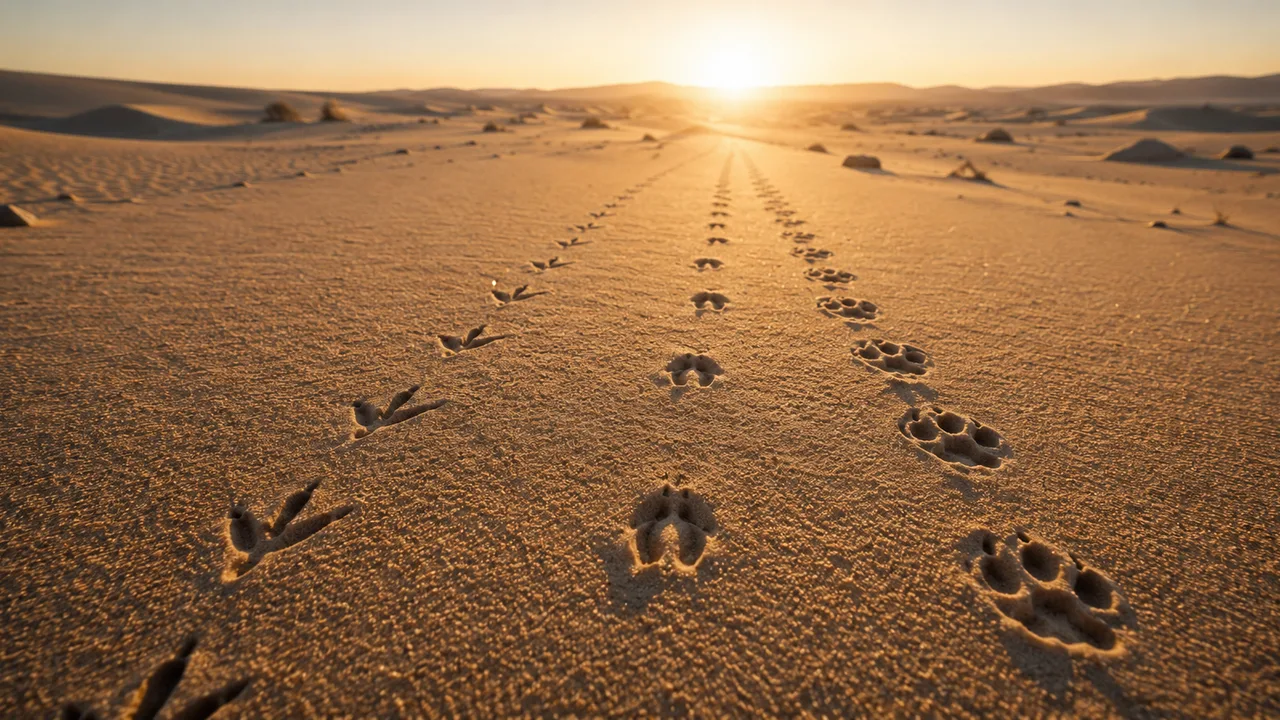
A hornless sheep will be given its retribution from the horned sheep that butted it. What the sources actually say about where animals end up.
On the Day of Judgment a sheep with no horns will be brought forward against a sheep with horns, because of a butt it took in a field nobody remembers. The Prophet ﷺ said the rights will be restored to the ones they belong to, until the hornless sheep is given its retribution from the horned sheep (Sahih Muslim, Kitab al-Birr). No people are involved. Nobody is watching except everybody.
So the short answer is that animals are gathered, and they are dealt with justly, and that much is certain. What happens next is where the popular answer and the classical books part company. In the report Abu Hurayra (RA) gives, once the accounts between the animals are settled they are told to be dust, which is exactly the thing the disbeliever will wish for himself on that Day. Jannah is not empty of animals, and the Quran puts birds on its tables. But the thing most people mean when they ask this question, that the animal they loved is raised into Paradise as its reward, is a view al-Qurtubi wrote down in his tafsir and then said was not sound.
And there is no creature on the earth or bird that flies with its wings except communities like you. We have not neglected in the Register a thing. Then unto their Lord they will be gathered (6:38).
Communities like you. Al-Qurtubi opens the whole discussion on that phrase, because everything depends on what the likeness is a likeness in. He lines the answers up.
Al-Zajjaj said the likeness is in creation, provision, death, resurrection and being brought to account. Mujahid said it is simpler than that, that they are distinct kinds with names by which they are known, the way you are known. Then Sufyan ibn 'Uyayna gave the one that stings. There is no kind of beast or bird, he said, without something like it walking around among people. Some men prey like the lion. Some are greedy like the pig. Some howl like the dog. Some strut like the peacock. Al-Khattabi liked that reading and put a warning on the end of it. You are keeping company with beasts and predators, so watch yourself.
And Surah al-Takwir confirms the gathering in four words, in the middle of a list of things that happen when the world ends. And when the wild beasts are gathered (81:5).
Al-Suyuti collected the fullest version of what happens at that gathering. Abu Hurayra (RA) said there is no beast and no bird but it will be gathered on the Day of Judgment, then retribution is taken between them, until it is taken for the hornless one from the horned one. Then it is said to them, be dust. Al-Suyuti names al-Hakim among those who accepted that report, and he brings it again in his commentary on Surah al-Naba through a second chain.
Read the next line of the Quran with that in your ear. Indeed, We have warned you of an impending punishment on the Day when a man will observe what his hands have put forth and the disbeliever will say, oh, I wish that I were dust (78:40).
He is not reaching for a metaphor. He has just watched a field of animals finish their business with each other, be dismissed into dust, and walk away from the whole afternoon owing nothing and facing nothing. He would take that trade. He is not offered it.
None of that means Paradise is a place with no living thing in it but people. And the meat of fowl, from whatever they desire (56:21). Birds are simply there, part of what Allah made in it.
There is also a narration about horses, and it is worth handling carefully because it gets quoted everywhere without its footnote. A man asked the Prophet ﷺ whether there are horses in Paradise, and the answer described a horse of red ruby that would carry him wherever he wished. A second man asked about camels and was not given the same reply. Al-Tirmidhi, who preserved it, added his own note underneath, that the report is not strong and that the man who narrates it was criticised. Al-Tabrizi carried both the narration and the note into Mishkat al-Masabih.
So keep the two apart. That Jannah contains animals is in the Quran. What a particular horse there looks like rests on a report its own collector was uneasy about.
Now the answer most people are actually looking for. Al-Qurtubi lists it, and he does not list it vaguely. He says other things have been said which are not sound: that they are like us in knowledge, that they are gathered and given bliss in Paradise, that they are compensated for the pains that came to them in the world, and that the people of Paradise take comfort in their forms.
Then his own conclusion. The sound meaning of communities like you is that they are created things, pointing to a Maker, needing Him, and provided for by Him, exactly as you are.
That is a hard sentence to read if you buried something you loved. It is also the honest state of the evidence, and a page that tells you what you want to hear here is a page that will tell you what you want to hear about bigger things later.
Here is what is not in question. On the same subject the Prophet ﷺ told the story of a man walking a road who was overtaken by thirst, went down into a well and drank, came out, and found a dog eating at the wet earth from thirst. The man said, this dog has reached the state I had reached. He went back down, filled his shoe with water, held it in his mouth as he climbed out, and gave the dog to drink. Allah thanked him for it and forgave him.
The Companions heard that and asked the obvious question. Is there reward for us in animals? He ﷺ said, in every moist liver there is reward (Sahih al-Bukhari 2234).
And the door swings the other way just as hard. A woman was punished over a cat that she confined until it died. She did not feed it, she did not give it water while she held it, and she did not let it go to eat from the creatures of the earth (Sahih al-Bukhari 2236).
Put those two beside the hornless sheep and the shape becomes clear. The question of whether animals are rewarded in Paradise is one the sources leave mostly closed. The question of whether they are counted is one the sources answer with a shoe carried in a man's teeth up the side of a well, and with a cat behind a door.
Nothing that happens to them is lost. That is the promise. A field, a well, a locked room, and a scale at the end of it that misses none of it.
Silsila Research Desk
Grade: Sahih · 7 min read