
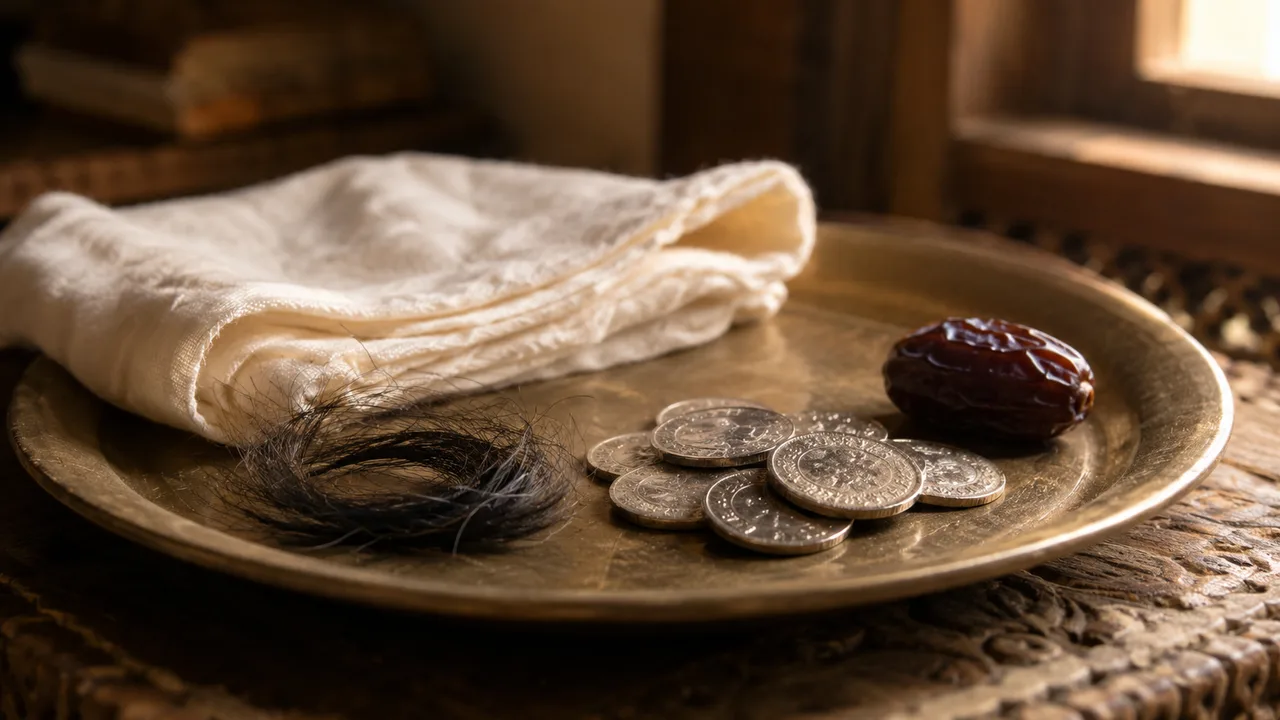
The adhan in the ear, the date on the tongue, the seventh day, the hair weighed against silver. What the classical book on the newborn puts in order.
Abu Rafi (RA) said he watched the Messenger of Allah ﷺ lean over a newborn and call the adhan into his ear. The child was Hasan (RA), on the day Fatima (RA) gave birth to him (Sunan Abu Dawud 5105, Jami al-Tirmidhi 1514). Before a name, before a cradle, before anyone in that house had slept.
What follows is shorter than most new parents expect. The adhan goes in the ear at birth. A softened date goes on the tongue at the first meeting, where he is often named too. The seventh day is the hinge: the aqiqah is offered, the head is shaved, and the weight of the hair is given away in silver. The circumcision belongs to the same early stretch, and the nursing runs on for two years. Almost none of it reaches day forty. The forty in the sources is a womb number. The Prophet ﷺ described the creation of one of us being gathered in his mother's belly for forty days, then the like of that, then the like of that again (Sahih al-Bukhari 3208). By the fortieth day outside, everything on the list except the feeding is already behind his parents.
Ibn al-Qayyim wrote a whole book on this, seventeen chapters, Tuhfat al-Mawdud bi-Ahkam al-Mawlud. Most of what follows is his, including the part nobody quotes: why any of it is there.
His reasoning for the adhan runs like this. The first thing to strike a person's hearing should be the words carrying the greatness of his Lord, and the testimony by which a person first enters Islam. So the child is taught the emblem of Islam at the moment he enters the world, exactly as the word of tawhid is prompted to a dying man at the moment he leaves it.
It is not far-fetched, he says, that the trace of those words reaches the child's heart though he does not perceive it. And the call to Allah arrives before the call of Shaytan, the way the fitrah a person is made on comes first.
He brings two further reports here, including the one about the iqamah in the left ear, and records his own verdict on their chains: they carry weakness. The right ear holds.
Abu Musa (RA) said a boy was born to him and he carried him to the Prophet ﷺ, who named him Ibrahim, rubbed his palate with a date, asked blessing for him and handed him back (Sahih al-Bukhari 5467). Asma (RA) brought her newborn, and the Prophet ﷺ set him in his lap, called for a date, chewed it and put it in the child's mouth, so that the first thing to go into him was the saliva of the Messenger of Allah ﷺ (Sahih al-Bukhari 5469).
In a third report the Prophet ﷺ did the same and named the child Abdullah (Sahih al-Bukhari 5470), so the naming often lands in that first visit. But the reports carry both timings, the birth day and the seventh day, and Ibn al-Qayyim prints both without forcing them together.
Four things attach to the weeks, Ibn al-Qayyim writes: the aqiqah, the shaving, the naming, the circumcision. The first two are on the seventh day by agreement. On the timing of the other two, he says, there is more than one view, and he leaves it there.
Then he explains the seven. When a child is born, his affair hangs between safety and ruin, and nobody yet knows whether he is of the people of life, until enough time passes for the soundness of his body to be read off him. The measure of that stretch was made the days of a week, because a week is a daily cycle the way a year is a monthly one.
Allah's wisdom runs to changing a person's state every seven days, so that seven is one of the stages a body moves through. Which is why you find a sick man's condition shift on the seventh day without fail, either toward strength or toward decline.
On that day the head is shaved. With the boy there is an aqiqah, the Prophet ﷺ said, so shed blood for him and remove the harm from him (Sahih al-Bukhari 5472). Al-Hasan al-Basri, asked what the harm was, said it means the head is shaved.
Then the hair is weighed. Ibn al-Qayyim quotes Malik's Muwatta: Fatima (RA) weighed the hair of Hasan (RA), Husayn (RA), Zaynab (RA) and Umm Kulthum (RA), and gave that weight in silver. In another report the Prophet ﷺ told her to shave the boy's head and give away the weight of his hair. They weighed it. It came to a dirham, or part of one. That is what the poor received.
In the days before Islam the blood of the slaughtered animal was smeared on the newborn's head instead. Imam Ahmad, asked whether a baby's head is marked with blood, said no, that is from the doing of the age of ignorance. Saffron was put in its place, and what replaced the blood, Ibn al-Qayyim writes, is more useful to the parents, to the child and to the poor at once.
Every boy is pledged by his aqiqah, the Prophet ﷺ said, slaughtered for on his seventh day, and his head is shaved, and he is named (Jami al-Tirmidhi 1522).
Pledged how? Ibn al-Qayyim quotes Imam Ahmad's reading: pledged from interceding for his parents. Ata ibn Abi Rabah read it the same way, and al-Khattabi called Ahmad's the best of the readings offered.
The animal is not a party. It is an offering made on the child's behalf at the very first of his time in the world, and Ibn al-Qayyim reads it as a ransom, the way Allah ransomed Isma'il (AS) with the ram. It is not far-fetched, he writes, that it should be a cause of the child growing well and staying guarded, so that every limb of the animal stands in for a limb of him. On the count, the reports name two comparable sheep for a boy and one for a girl, and al-Tirmidhi records in the same breath that a single sheep was offered for Hasan (RA). Imam Ahmad was asked what a father does who cannot afford it. If he borrows for it, he said, I hope Allah gives it back to him. He has revived a sunnah.
Circumcision he treats as a mark rather than a procedure. It completes the fitrah, he writes, and it is the sign of the covenant made with Ibrahim (AS), marked in the body itself. It stands for the people of Ibrahim (AS) where baptism stands for the worshippers of the cross.
Then the long part. Mothers may nurse their children two complete years for whoever wishes to complete the nursing period (2:233). Ibn al-Qayyim reads the word complete as deliberate, so that nobody can shave the two years down. The same verse allows the parents to wean earlier by agreement and consultation between them, and he adds that weaning should be done by degrees, never sprung on a child at once.
He notices the teeth too. Allah held them back, he writes, until the child needed solid food, out of mercy to the mother and the softness of her breast, so that the child would not bite her.
Writing about the moment a child begins to talk, Ibn al-Qayyim repeats the instruction he gave for the delivery room. Prompt him with there is no god but Allah, Muhammad is the Messenger of Allah. Let the first thing that strikes their ears be the knowledge of Allah.
The same phrase, used for a baby forty seconds old and again for a child of two, as though the whole stretch between them were one long sentence being said slowly.
None of this is a ruling. It describes what one classical book and the collections behind it record, and where the sources carry more than one practice, ask whoever teaches your family its fiqh. What they agree on is the shape: a word, a date, a seventh day, a coin's weight of hair, two years of milk.
Silsila Research Desk
Grade: Sahih · 7 min read