
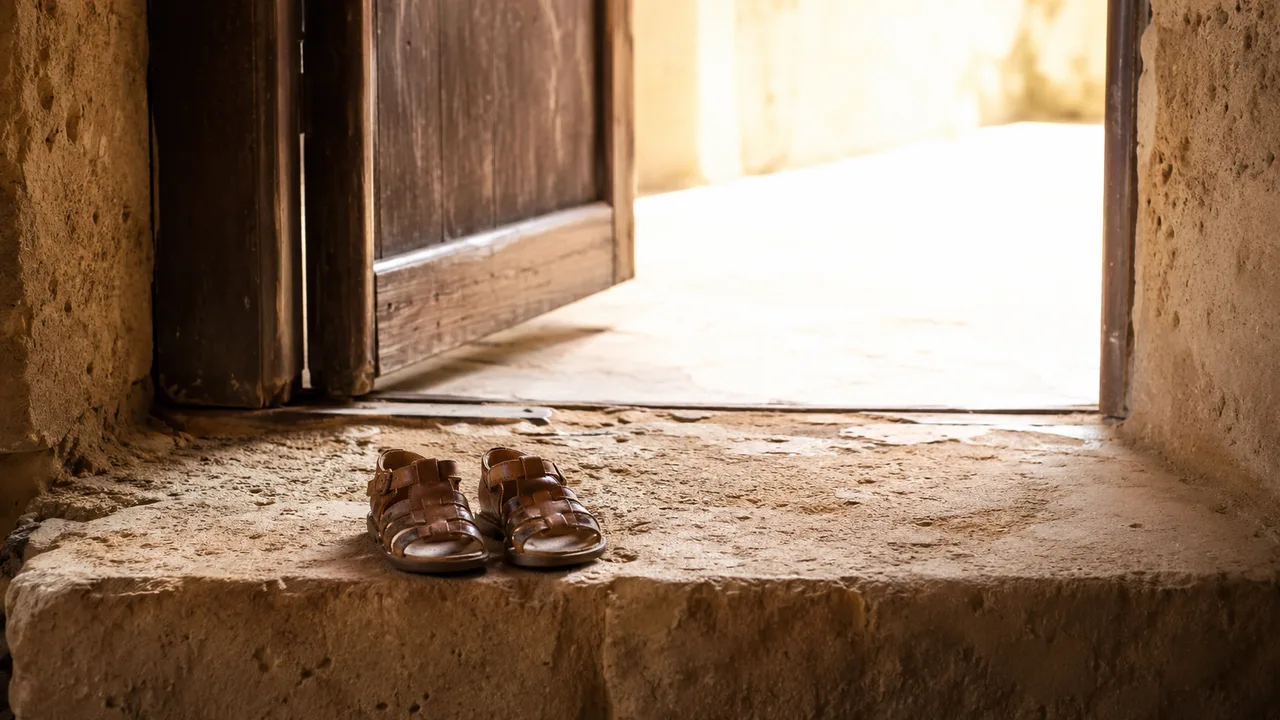
The Prophet ﷺ wept when his own infant son died and called the tears mercy. What the narrations promise a grieving parent is a reunion.
A blacksmith's house on the edge of Madinah, and a baby taking his last breaths in it. The father holding him was the Prophet Muhammad ﷺ. The baby was his son Ibrahim. Anas ibn Malik (RA) was standing close enough to watch the Prophet ﷺ pick him up, kiss him, hold him against his face, and then begin to cry.
That is where the honest answer to this question starts, because it settles something before any explanation does. The narrations do not ask a parent to be composed about a dead child. What they transmit is this. A Muslim child who dies before reaching puberty is in Paradise. The parent who carries the loss is promised Paradise through it. The child is described as waiting there and holding on to the parent until the parent is let in. And no soul, however small, is answerable for anything it did not earn.
Abdur Rahman ibn Awf (RA) saw the tears and said what most of us would say out loud. O Messenger of Allah ﷺ, even you are weeping. He answered, O Ibn Awf, this is mercy. Then he wept more, and said, the eyes are shedding tears and the heart is grieved, and we will not say except what pleases our Lord. O Ibrahim, indeed we are grieved by your separation (Sahih al-Bukhari 1303).
Read that again slowly, because there is a line drawn inside it. Grief is not the failure. The tears are named as mercy, not as a crack in someone's faith. The one limit set is on the tongue, that nothing be said which displeases Allah. Everything else, the crying, the ache in the chest, saying the child's name out loud years later, sits inside what the Prophet ﷺ himself did in that room.
Al-Bara ibn Azib (RA) transmitted that when Ibrahim died, the Prophet ﷺ said there is a wet-nurse for him in Paradise (Sahih al-Bukhari 1382).
Sit with how small and how domestic that is. Not a throne. Not a rank. A nurse. The child is described as still being a child, still needing to be fed, still being looked after by someone, and the looking after is happening in Jannah.
Anas ibn Malik (RA) transmitted that the Prophet ﷺ said any Muslim whose three children died before the age of puberty will be granted Paradise by Allah because of His mercy to them (Sahih al-Bukhari 1381).
Then a group of women asked the Prophet ﷺ to set aside a day for them, and in that gathering he said a woman whose three children died would be screened from the Hellfire by them. One woman in the crowd could not let it pass. And if two died, she asked. He said, even two (Sahih al-Bukhari 1249). Abu Hurairah (RA) added that the children spoken of were below the age of puberty.
That interruption is the most human moment in this entire subject. A mother sitting in a gathering doing arithmetic on her own dead children, afraid her number was too small to count. He did not correct her for asking. He lowered the number.
Years later a man came to Abu Hurairah (RA) and told him his two children had died, and asked if there was anything from the Prophet ﷺ that might soothe their hearts. Abu Hurairah (RA) said yes, and narrated this. Small children are the fowls of Paradise. When one of them meets his father, or he said his parents, he takes hold of his garment the way I am taking hold of the hem of your cloth right now. And he does not take his hand off it until Allah admits his father into Paradise (Sahih Muslim 2635).
Notice what Abu Hurairah (RA) was doing with his hands while he said it. He reached out and gripped the grieving man's clothing so the man could feel the narration on his own sleeve. The child in it is not a spectator waiting to be reunited. The child is described as the one doing the pulling.
The Quran puts the reunion in plain terms. And those who believed and whose descendants followed them in faith, We will join with them their descendants, and We will not deprive them of anything of their deeds (52:21).
Ibn Kathir, commenting on this verse, records Ibn Abbas (RA) saying that Allah raises the children of the believers to the rank of their parents even where the children never did the deeds that rank was earned by, so that the eyes of the parents are comforted, and that no part of the parents' reward is taken away to pay for it.
Read that last part again. The reunion is not a trade. Nobody is charged for it.
The same verse closes with a hard clean line. Every person, for what he earned, is retained. And elsewhere, no bearer of burdens will bear the burden of another (6:164).
This quietly answers the fear sitting underneath the question. A parent who loses a child almost always turns the search inward and starts hunting for the sin that caused it, the missed prayer, the old debt, the thing said in anger. The Quran cuts that at the root. Nobody carries anybody else's load. Not the child for the parent. Not the parent for the child.
And the children who were not born to Muslim parents. The Prophet ﷺ was asked exactly that, and his answer was that Allah created them, so He knows what sort of deeds they would have done (Sahih al-Bukhari 1383). A matching answer is transmitted from Abu Hurairah (RA).
The narrations on this differ from one another, and anyone who hands you a tidy verdict is walking past what was actually transmitted. What was transmitted is that the matter was left with Allah. As for what Allah is like in a matter He keeps to Himself, there is one scene that says more than an argument could.
Captives were brought before the Prophet ﷺ, and among them was a woman who had lost her own child. She was moving through the prisoners with her milk coming in, and every time she found a small child she pulled it to her chest and fed it. Then she found her own and held him. The Prophet ﷺ turned to the men around him and asked, do you think this woman would throw her child into the fire. They said no, not if she had any power to stop herself. He said, Allah is more merciful to His slaves than this woman is to her child (Sahih al-Bukhari 5999).
Then the narrations are not asking you to stop missing your child. The Prophet ﷺ did not stop. He stood in a blacksmith's house with his son going still in his arms and said out loud that his heart was grieved, and in the same breath handed the whole thing back to Allah.
What was transmitted is that a Muslim child who dies is somewhere being fed. And what was transmitted about the day you arrive is that they will be the one holding on to you.
Silsila Research Desk
Grade: Sahih · 7 min read