
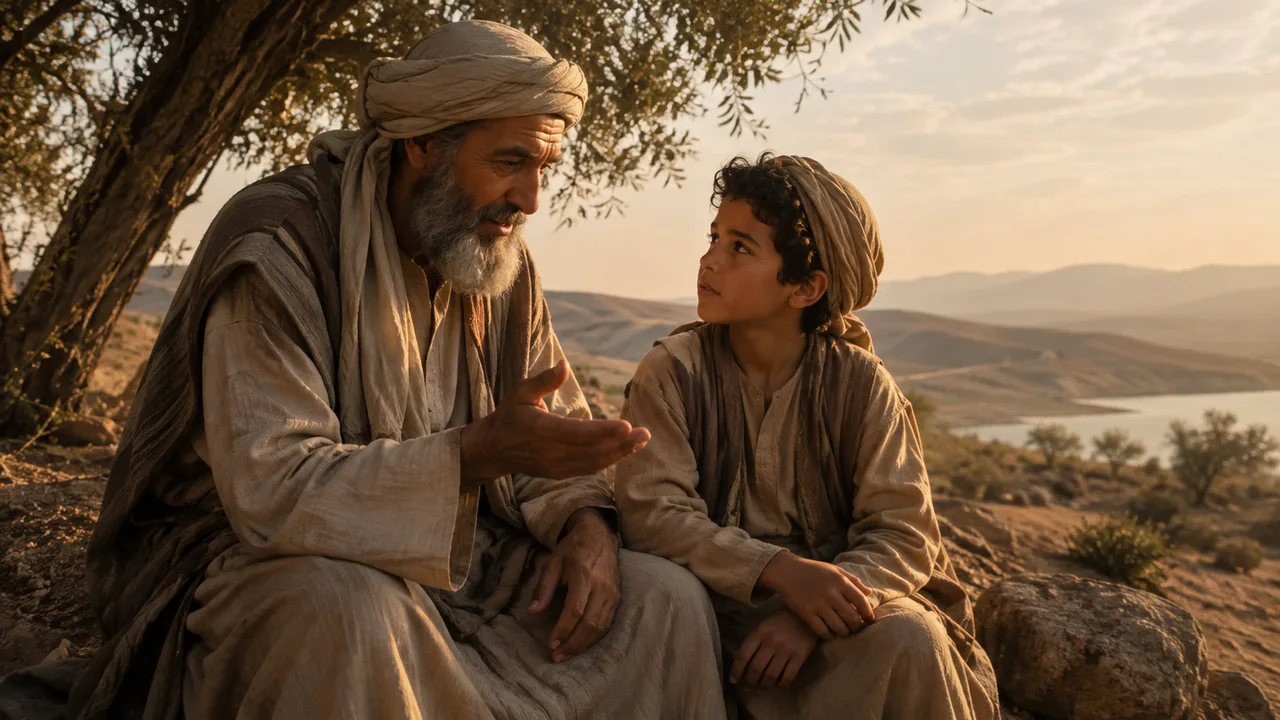
He was not a king and, by most accounts, not a prophet. Yet Allah recorded one talk with his son and named a surah after him. Eight lessons, still unbeaten.
The Quran contains surahs named after prophets, after battles, after the Day of Judgment itself. And then there is a surah named after a father talking to his son. Luqman commanded no army and ruled no kingdom, and by the position of most scholars he was not even a prophet, just a righteous man to whom, as the Quran states, "We had certainly given Luqman wisdom" (31:12). Out of everything that man ever said, Allah selected one conversation, a father's advice session with his boy, and preserved it in the eternal Book as the model curriculum for raising a human being. If you want to know what Allah considers essential parenting, it is all here, in eight lessons.
Before the advice begins, notice what wisdom meant in Luqman's case. The verse that introduces his gift immediately defines it: "Be grateful to Allah. And whoever is grateful is grateful for the benefit of himself" (31:12). The first fruit of wisdom is not clever sayings. It is shukr, the settled recognition of where everything comes from. A man who has that has the root of all wisdom; a genius who lacks it has organised ignorance.
Notice also the tone the Quran preserves. Three times in the passage, Luqman addresses his son as ya bunayya, an Arabic diminutive of affection, closer to "my dear little son" than to "boy". The most important curriculum in the Quran is delivered in the softest register the language has. That is itself the first parenting lesson, before any content: wisdom travels on tenderness.
Lesson one: "O my son, do not associate anything with Allah. Indeed, association with Him is great injustice" (31:13). Luqman does not open with manners or career advice. He opens with tawhid, and he gives the reason in a form a child can carry: shirk is zulm, injustice, the misplacement of what is owed. Giving worship to what did not create you is the deepest wrong a heart can commit.
The weight of that sentence was confirmed by the Prophet Muhammad ﷺ himself. When the verse came down saying those who believe "and do not mix their belief with injustice" are the secure ones, the companions were distressed, which of us has never done any injustice? The Prophet ﷺ answered them, as recorded in Sahih al-Bukhari, by quoting Luqman: it is not as you think; it is as Luqman said to his son, shirk is the great injustice. A wise man's sentence to his child became the Prophet's ﷺ own proof text.
Immediately, Allah interleaves a command of His own into the conversation: "And We have enjoined upon man care for his parents. His mother carried him, increasing her in weakness upon weakness, and his weaning is in two years. Be grateful to Me and to your parents" (31:14). Look at the placement: gratitude to parents is fused into the same sentence as gratitude to Allah, and the mother's account is itemised, weakness upon weakness.
Then a boundary that proves this is no blind obedience: if parents strive to drag you into shirk, "do not obey them, but accompany them in this world with appropriate kindness" (31:15). Refuse the sin, keep the kindness. In one verse, Islam threads the needle entire cultures fall on either side of.
Lesson three may be the most quietly terrifying sentence ever addressed to a child: "O my son, indeed if a wrong should be the weight of a mustard seed and should be within a rock or anywhere in the heavens or in the earth, Allah will bring it forth. Indeed, Allah is Subtle and Aware" (31:16).
A mustard seed, inside a rock. No witness, no camera, no record, and it will be produced on the Day the accounts are read. Luqman is installing a conscience, the inner surveillance that works precisely where outer surveillance cannot. A child who absorbs this verse does not behave well because someone is watching. He behaves well because Someone always is.
Then the practical program: "O my son, establish prayer, enjoin what is right, forbid what is wrong, and be patient over what befalls you. Indeed, all that is of the matters requiring resolve" (31:17). Four items, in order. Prayer first, the private connection. Then public responsibility, standing for right and against wrong. And then, immediately, patience, because Luqman is honest with his boy about the invoice: if you stand for anything, things will befall you. The father does not promise a smooth road. He prescribes the spine for a rough one.
The curriculum ends where most curricula never go: posture and volume. "And do not turn your cheek in contempt toward people, and do not walk through the earth exultantly. Indeed, Allah does not like everyone self-deluded and boastful" (31:18). The turned cheek, the strut, arrogance is a body language before it is a belief, and Luqman bans the gestures themselves. Then the closing counsel: "Be moderate in your pace and lower your voice; indeed, the most disagreeable of sounds is the voice of donkeys" (31:19). The wisdom that began at the throne of Allah ends at the volume knob, sealed with the one flash of sharp humour in the passage, because a wise father knows a teenager remembers a joke about donkeys longer than a lecture on humility.
So who was Luqman? The accounts relay little with certainty about the man, some say he was from Abyssinia, and the majority of scholars hold he was a wise servant of Allah rather than a prophet. And that may be exactly the point of his inclusion. Prophets are chosen; wisdom is available. The Quran's model educator is not a miracle worker but a father who got the order right: Allah first, parents second, conscience third, prayer and patience as the daily spine, humility down to the way you walk and the level of your voice.
Eight lessons, one gentle refrain of ya bunayya, and a place in the eternal Book ahead of kings and conquerors. Every parent since has been handed the same syllabus. The only question Surah Luqman leaves open is whether we will teach it as tenderly as he did.
Silsila Research Desk
Grade: Sahih · 6 min read