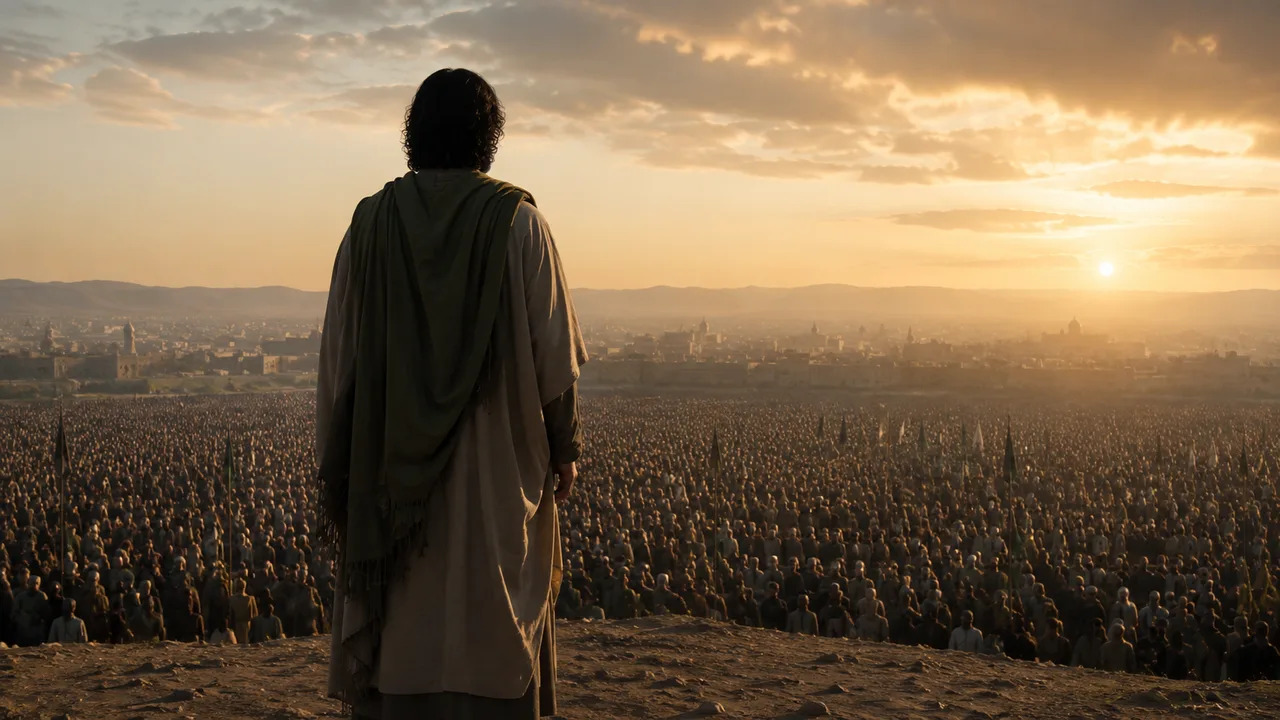
A man with an ordinary name will lead the world's last just government, and a prophet will pray behind him. The hadith give a job description, not a legend.
Near the end of history, according to the Prophet Muhammad ﷺ, the most important man on earth will be someone with a completely ordinary name, born to ordinary parents, holding no prophethood, working no miracles. And a prophet of Allah will stand behind him in prayer. That inversion, a messenger praying behind a non-messenger, is the single detail that tells you how seriously Islam takes this figure. Muslims call him the Mahdi, the rightly guided one, and the sober hadith record about him is very different from the legends that have grown around his name.
Start with an honest note: the Mahdi is not named anywhere in the Quran. What the Quran gives is the backdrop, a standing promise about how the story of the earth resolves: "And We have already written in the book after the previous mention that the land is inherited by My righteous servants" (21:105). And: "Allah has promised those who have believed among you and done righteous deeds that He will surely grant them succession upon the earth" (24:55). Righteous inheritance is the trajectory. The Mahdi's specific file lives in the hadith collections, in narrations the scholars graded and accepted.
The core report is startling in its confidence: if there were only one day left of the world, the Prophet ﷺ said, Allah would lengthen that day until He sends a man from my family, whose name agrees with my name and whose father's name agrees with my father's name, and he will fill the earth with equity and justice as it was filled with oppression and injustice.
Unpack the details. He is from the Prophet's ﷺ own house, and another narration specifies further: from the descendants of Fatimah (RA). His name will match the Prophet's ﷺ name, and his father's name the name of the Prophet's ﷺ father. And his mission statement is symmetry: the earth will be as full of justice as it was of injustice. The hadith assumes a world drowning in oppression, which is to say, it assumes a world we would recognise.
Almost everything popularly attached to the Mahdi needs trimming back to the sources. He is not a prophet; revelation ended with Muhammad ﷺ. He is not a miracle worker by trade; nothing in the hadith record hands him supernatural powers. He is not hiding in a cave or living for centuries in concealment; in the Sunni hadith record he is simply a man who will be born, live, and be found among the Muslims when history requires him. The scholars relay that he will be corrected and prepared by Allah, the word Mahdi itself means guided, not self-made.
He is, in short, a job description: a ruler from the Prophet's ﷺ family, bearing his name, governing with justice. The most remarkable thing about him is not what he can do but when he appears, at the hinge of history, with the trial of the Dajjal gathering and the world's need for just leadership at its most desperate.
One scene in Sahih Muslim outranks every legend. The Prophet ﷺ described the descent of Isa (AS), the true Messiah returning at the end of time, arriving while the Muslims are assembled for prayer. And the imam of the Muslims will step back to offer his place, and the word will come that the prayer had been established for this imam, and Isa (AS) will pray behind him. The commentators relay that this imam is the Mahdi.
Hold that image. A prophet who spoke from the cradle, who healed and revived by Allah's permission, declines to lead and stands in the row behind a man of this ummah. The scholars saw in this a deliberate honour conferred on the community of Muhammad ﷺ: its final leader is dignified in front of the whole world, and prophethood itself bears witness that this ummah's prayer, and its order, are valid to the last day.
Here a warning the topic demands. Because the Mahdi's arrival promises the end of oppression, his name has been the most stolen title in Islamic history. Century after century, men have declared themselves the Mahdi, gathered followers, and led them into disaster. The pattern is old and the lesson is simple: the hadith describe a man recognised by his justice and his circumstances, not a man running a recognition campaign. A claimant demanding your allegiance is, by that very demand, failing the description. The believer's posture toward the Mahdi is the same as toward every unseen promise: trust the report, ignore the impostors, and be found doing your own duty when the news is real.
It would be easy to file the Mahdi under distant curiosities. But consider what the belief actually installs in a Muslim's heart. History does not end with the oppressors winning. The long ledger of stolen lands and crushed peoples is not the final page; Allah has scheduled a correction, led by a man from the house of the one who was himself driven out of his city ﷺ. "The land is inherited by My righteous servants" (21:105) is not poetry. It is policy, with a name attached.
So who is Imam Mahdi? A man not yet known, with the Prophet's ﷺ name and the Prophet's ﷺ blood, who will lead the last just order of this world, host the return of Isa (AS), and prove, at history's darkest hinge, that the promise written after the previous mention was never forgotten. He needs nothing from us before his time. Until then, the hadith leave every believer the same assignment his era will reward: be among the righteous servants the inheritance was promised to.
Silsila Research Desk
Grade: Sahih · 6 min read