
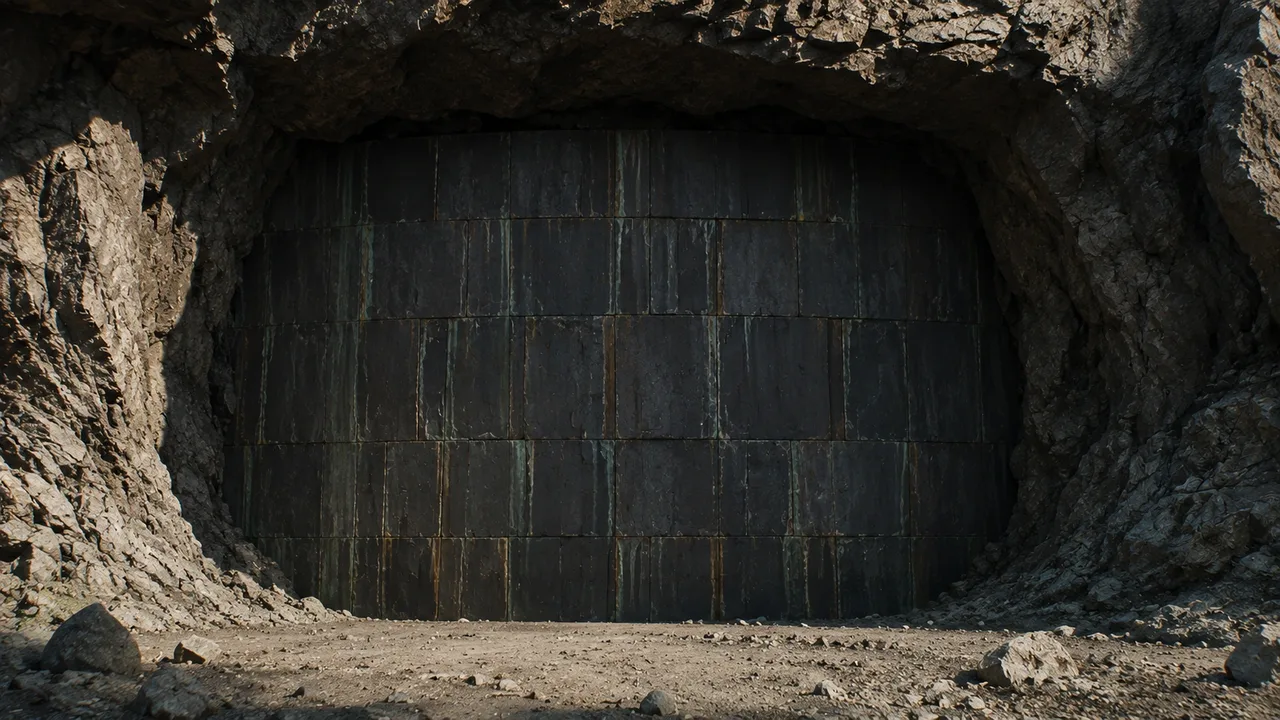
Behind a wall of iron and molten copper waits a nation no army can fight. Who they are, who locked them in, and what happens the day the wall comes down.
One night in Madinah, the Prophet ﷺ woke from his sleep with his face flushed, saying: "Woe to the Arabs from a danger that has come near. An opening has been made in the wall of Gog and Magog like this," and he made a circle with his finger and thumb. A hole the size of a coin, in a wall somewhere on earth, and the best of creation ﷺ lost sleep over it. So who are Yajuj and Majuj? Not monsters, not myth: two human nations, descendants of Adam like us, so vast and so destructive that a righteous king sealed them behind a barrier of iron and copper, and their release is one of the locked signs of the end of the world. The Qur'an tells the story of the wall going up. The hadith tells the story of the day it comes down. Both are worth reading before the news does it for you.
The Qur'an introduces them through Dhul-Qarnayn, a ruler Allah established in the earth, who arrived at a pass between two mountains and met a people barely able to understand speech. They had one request: "O Dhul-Qarnayn, indeed Gog and Magog are great corrupters in the land. So may we assign for you an expenditure that you might make between us and them a barrier?" (18:94).
His answer is a masterclass in leadership. He refused the money: "That in which my Lord has established me is better, but assist me with strength" (18:95). Then the engineering, recorded step by step: "Bring me bars of iron, until, when he had leveled them between the two mountain walls, he said: Blow, until when he had made it like fire, he said: Bring me, that I may pour over it molten copper" (18:96). Iron core, heated to furnace temperature, sheathed in copper. The result: "So they were unable to pass over it, nor were they able to effect in it any penetration" (18:97). Too smooth to climb, too hard to tunnel.
Where is it? Nobody can say with certainty, and honesty is better than a map drawn from guesswork. What the texts guarantee is not the coordinates. It is the schedule.
Dhul-Qarnayn finished the greatest construction project in scripture, looked at it, and claimed no credit: "This is a mercy from my Lord; but when the promise of my Lord comes, He will make it level, and ever is the promise of my Lord true" (18:98).
Read that closely. The builder himself filed the demolition notice. The wall is a mercy with a term limit, and the Qur'an picks up the thread at the end of time: "Until, when the dam of Gog and Magog has been opened and they, from every elevation, descend. And the true promise has approached; then suddenly the eyes of those who disbelieved will be staring in horror: O woe to us, we had been unmindful of this" (21:96-97). From every elevation. The image is water finding every slope at once, a flood with faces.
And their number? The Prophet ﷺ described that on the Day of Judgment, Adam will be told to send forth the delegation of the Fire, and of every thousand, nine hundred and ninety nine will be from Yajuj and Majuj. Whatever their census is, it makes the rest of humanity a rounding error.
The long hadith of the end times, narrated by an-Nawwas ibn Sam'an, places their release immediately after one of history's greatest victories. Isa, peace be upon him, has just killed the Dajjal. The worst enemy imaginable is dead. And then Allah reveals to him words with no precedent: "I have brought forth servants of Mine against whom none has power to fight; take My servants to Tur."
Sit with that sentence. A prophet who just ended the Dajjal is told: this one is not yours to fight. Retreat. The hordes pass the lake of Tiberias and the first ranks drink it dry, so the last ranks look at the basin and say: there was once water here. That is the hadith's way of measuring them, not in numbers but in emptied lakes.
Then the ending, and it is nothing like the buildup. No battle. No hero. Isa and his companions, besieged on the mountain, turn to the only weapon left and pray. And Allah sends against the unfightable nation the naghaf, worms in their necks, and by morning they are dead, the narration says, as one soul.
The armies that no weapon could stop are dropped by something too small to see. The earth reeks with them until Allah sends birds with necks like camels to carry the bodies away, then a rain that washes the world clean. The whole account is a single lesson stretched across a horizon: power belongs to Allah alone. He walls nations in with iron when He wills, and unmakes them with worms when He wills.
Come back to the Prophet ﷺ waking flushed in the night. A companion asked the question you would have asked: shall we be destroyed while there are righteous among us? His answer: "Yes, when evil increases."
That is the transferable part of the whole file. You cannot locate the wall, reinforce it, or schedule its fall. The one variable the hadith hands to ordinary people is the level of corruption a society tolerates while calling itself safe. Yajuj and Majuj wait behind their barrier on Allah's calendar. The barrier you are responsible for is smaller, closer, and made of what you enjoin, what you forbid, and what you quietly let slide.
Silsila Research Desk
Grade: Sahih · 7 min read