
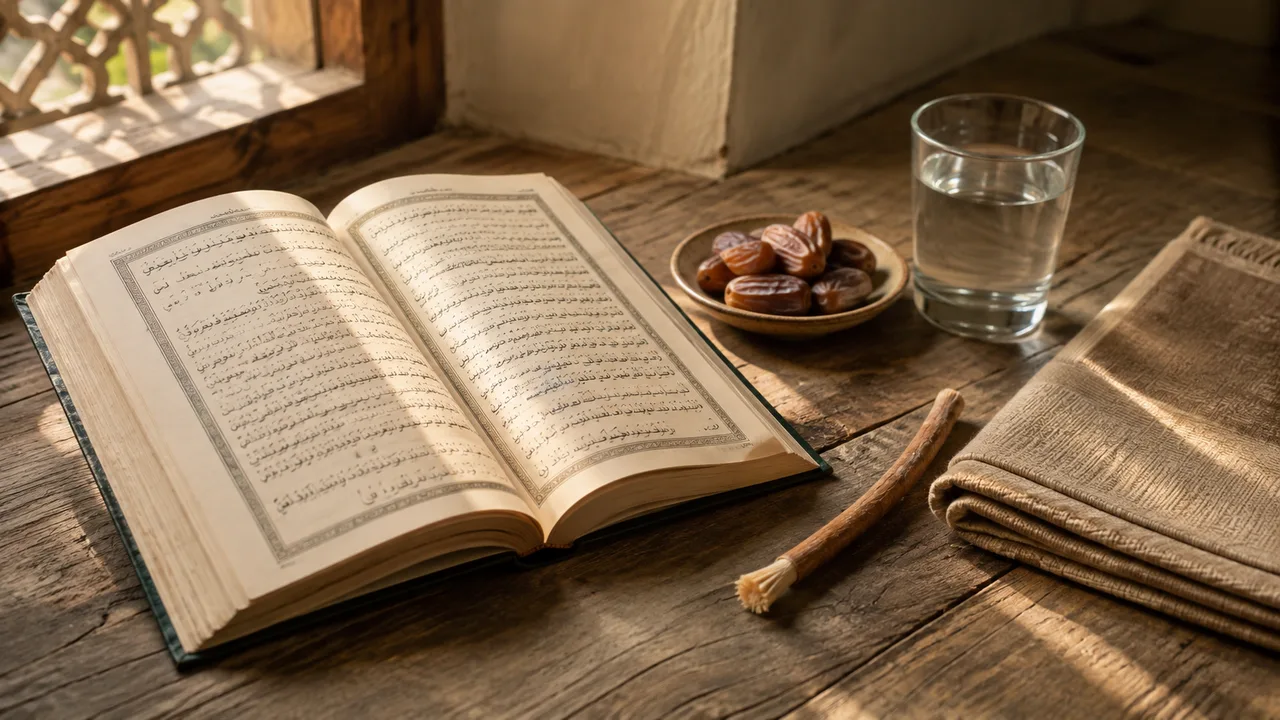
A man eats with his right hand and calls it worship, because the Prophet ﷺ did it first. What the Sunnah actually is, and why it still governs ordinary life.
A man eats with his right hand. He begins a task by saying the name of God. He turns his whole body toward a stranger who is speaking to him, instead of half listening. None of this is written out as a numbered law in the Quran. Yet across the world today it still happens the same way it happened once, in one house, in one city, fourteen hundred years ago. It happens because one man did it first and called it worship. That is the Sunnah, the way of the Prophet Muhammad ﷺ: everything he said, did, and quietly allowed, kept and carried forward as the working example of how a book of guidance turns into an actual life.
Ask a Muslim what the Sunnah is and the short version comes back the same: it is the Prophet's ﷺ example. But an example of what? Of everything. His words in a gathering. His patience when someone wronged him. The order he put his sandals on. The way he mended a quarrel between two neighbours before it hardened into a feud. The Quran gave the command; the Prophet ﷺ gave the demonstration. Between revelation and daily life, the Sunnah is the bridge, and Muslims have spent fourteen centuries walking across it rather than guessing at the far bank alone.
People use Sunnah and hadith as if they are twins, and the mix-up is understandable, but the two answer different questions. The Sunnah is the thing itself, the Prophet's ﷺ actual way of living. A hadith is the report that carries that way of living to us: this companion said, this is what I saw the Prophet ﷺ do, this is what he told me. Without the hadith literature, the Sunnah would be a rumour with no path back to its source. Every hadith carries its own chain of names, one person telling the next, all the way back to someone who was actually in the room. That chain is why a Muslim today can trust that eating with the right hand, or turning fully toward someone speaking to you, did not appear last century. It walked here, name by name, from a house in Madinah.
The Quran does not leave this to inference. It says outright, of the Prophet ﷺ: "There has certainly been for you in the Messenger of Allah an excellent pattern for anyone whose hope is in Allah and the Last Day and who remembers Allah often" (33:21). A pattern, not a suggestion. The word describes something you trace and repeat, not something you admire from a distance.
The same chapter that carries the boldest claim about love ties it directly to imitation. The Prophet ﷺ was told to say to people: "If you should love Allah, then follow me, and Allah will love you and forgive you your sins" (3:31). Love of God, in this verse, is not measured by feeling. It is measured by whether you follow the man Allah sent to show you how.
And obedience to him is folded into obedience to Allah without a seam between them: "He who obeys the Messenger has obeyed Allah" (4:80). There is no separate lane for following the Prophet ﷺ as an optional extra, sitting beside the real obligation of worshipping God. The verse removes the gap entirely. One obedience, one line, no fork in it.
One verse turns the principle into something concrete rather than abstract. It was revealed about how to divide wartime property fairly, so that wealth would not pool only among the rich, but it adds an instruction that reaches far past that one situation: "And whatever the Messenger has given you, take; and what he has forbidden you, refrain from" (59:7). Early commentary on this verse reads that line as a standing order, not confined to the original case: whatever he commands, do it; whatever he forbids, leave it. A specific ruling about property became, in the same breath, a general rule about how a believer relates to everything the Prophet ﷺ said.
The clearest lesson on what the Sunnah actually asks of a person came from a mistake three companions made. They went to the Prophet's ﷺ wives to ask about his private worship, and hearing how he prayed and fasted, decided it sounded too modest for men serious about their faith. One vowed to pray through every night without stopping. Another swore off breaking his fast, ever. A third said he would never marry. Word reached the Prophet ﷺ, and he did not thank them for their zeal. He praised Allah, then corrected them in front of everyone: "I am more fearful of Allah and more mindful of Him than you, yet I fast and I break my fast, I pray and I sleep, and I marry women. Whoever turns away from my Sunnah is not of me." The Sunnah, in that one sentence, stopped being a ceiling to strain toward and became a floor: not the outer limit of devotion, but its actual shape. Extremism invented past what he modeled was the very thing he ﷺ ruled outside of religion.
Near the end of his life, in a report preserved in Imam Malik's Muwatta, the Prophet ﷺ is remembered describing exactly what he was handing to the generations after him: two things, and only two, that would keep them from losing their way if they held onto both, the Book of Allah and the Sunnah of His Prophet. Not the Book alone. Both together, the way a lock needs its key.
This is why a Muslim eating with the right hand is not performing a quirky custom. It is a small, repeatable act of following, the same motion the Prophet ﷺ made, kept alive by people who wanted to inherit not just his message but his manner. The Sunnah does not ask for a leap of imagination about what a good life looks like. It hands over a life that was already lived, in full view of witnesses who wrote down what they saw, so that fourteen hundred years later, the way you greet a stranger, sleep at night, or forgive someone who wronged you, can still trace back to a man in Madinah who did it first, and called it worship.
Silsila Research Desk
Grade: Sahih · 7 min read