
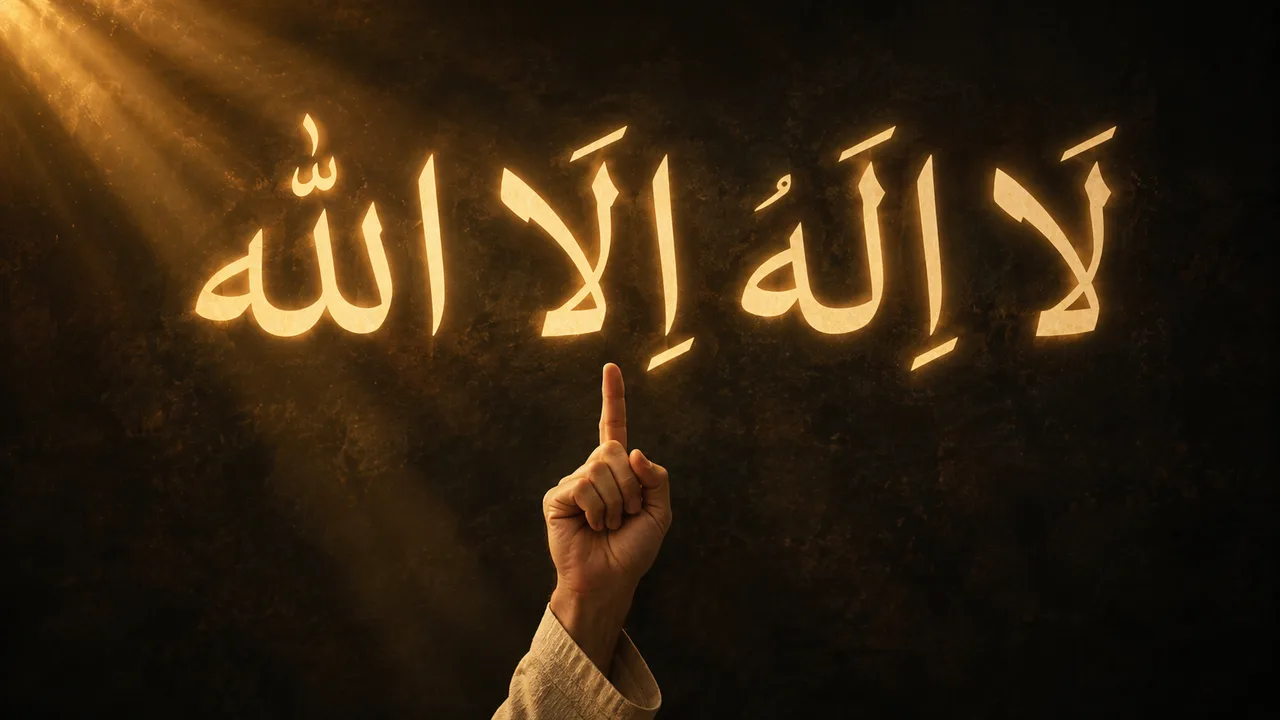
The two sentences that turn a person into a Muslim, and the last words every Muslim hopes to say before they die.
A man is dying, and someone leans close to his ear and says one sentence to him, nothing more. There is no god but Allah, Muhammad ﷺ is the messenger of Allah. That sentence has a name. It is the Shahada, the testimony, and it is the one line that makes a person Muslim the moment they say it and mean it, and the line every Muslim hopes is the last thing they ever say before they leave this world.
Two testimonies live inside it. La ilaha illa Allah: there is no god but Allah. Muhammadur rasul Allah: Muhammad ﷺ is the messenger of Allah. Say both, mean both, and you have entered Islam. No ceremony is required beyond that, no committee, no waiting period. The door into the largest family of belief on earth is one sentence wide, and it stays open for anyone who wants to walk through it, at any hour, from any starting point.
Start with the first half, because everything else in Islam rests on it. There is no god but Allah. Not a god among gods. Not the strongest of several. None at all, except Him. The Quran states this as a fact so certain that it calls its own witnesses: "Allah witnesses that there is no deity except Him, and so do the angels and those of knowledge, maintaining creation in justice. There is no deity except Him, the Exalted in Might, the Wise" (3:18). Read who is testifying. Not preachers. Not a nation. Allah Himself, then the angels, then the people who actually studied the matter. The verse is not asking you to take a leap in the dark. It is telling you that the claim has already been examined by the only witnesses whose testimony could possibly matter, and the verdict came back unanimous.
Another verse puts the same claim as a command aimed straight at the reader: "So know that there is no deity except Allah and ask forgiveness for your sin and for the believing men and believing women" (47:19). Notice the order. Know first. Not feel, not hope, not assume. Know, the way you know a fact, the way the ground under your feet is a fact. Everything that follows in a Muslim's life, the prayer, the fasting, the way a person treats a neighbour or a stranger, is built on top of that one settled fact.
Not everyone who hears the sentence can say it, and the Quran does not pretend otherwise. It describes a crowd that heard it and reacted with the opposite of relief: "Indeed they, when it was said to them, there is no deity but Allah, were arrogant" (37:35). The sentence is short enough for a child to repeat, yet it cost some grown men their pride to say, because it asks something specific of the person saying it. It asks you to hand over the throne. Not your money, not your comfort, your throne, the place inside you that wants to be the final authority on your own life. Some people will give up almost anything before they give up that. The Shahada asks for it first.
The first testimony tells you who to worship. The second tells you how, because a claim about the unseen needs a messenger to carry it into a human life you can actually copy. That is where Muhammad ﷺ enters the sentence, not as an object of worship, but as the one sent to deliver and demonstrate the first half. The Quran names him plainly: "Muhammad is the Messenger of Allah, and those with him are forceful against the disbelievers, merciful among themselves. You see them bowing and prostrating, seeking bounty from Allah and His pleasure. Their sign is in their faces from the effect of prostration" (48:29). And it closes the line of prophets with him specifically: "Muhammad is not the father of any one of your men, but he is the Messenger of Allah and seal of the prophets. And ever is Allah, of all things, Knowing" (33:40). Seal means last. No one after him carries the title. The chain of messengers that began with the first human being ends with him, which is why the second half of the Shahada is not decoration. It is the reason a Muslim today has any idea what the first half is supposed to look like in a life.
Go back to the deathbed, because that is where the Shahada shows its full weight. A companion of the Prophet ﷺ named Muadh ibn Jabal narrated something the Prophet ﷺ said about exactly this moment, recorded in Sunan Abi Dawud: whoever's last words are there is no god but Allah will enter Paradise. Read what that sentence is doing. It is not describing a reward for a lifetime of perfect record keeping. It is describing a door that stays open until the very last breath, wide enough for a life full of mistakes to walk through it one final time and mean it.
This is why families whisper it into a dying relative's ear, gently, without pressure, the way you would remind someone of the one thing that actually matters when everything else has already stopped mattering. Not because the words are magic on their own, but because they are the truest sentence a human being can end their life saying, the same sentence that started their life as a Muslim in the first place, if they said it and meant it.
Two testimonies, one truth. There is no god but Allah. Muhammad ﷺ is His messenger. A person can say it in a hospital bed at ninety, or in a quiet room at nineteen, or on the day they were born into a Muslim household and grew up believing it before they understood a word of it. It works the same way every time, because it was never a password for insiders. It is the plainest sentence in the religion, sitting at both ends of a Muslim life, at the door coming in and at the door going out, asking the same question each time: who do you belong to, and are you ready to say so.
Silsila Research Desk
Grade: Sahih · 7 min read