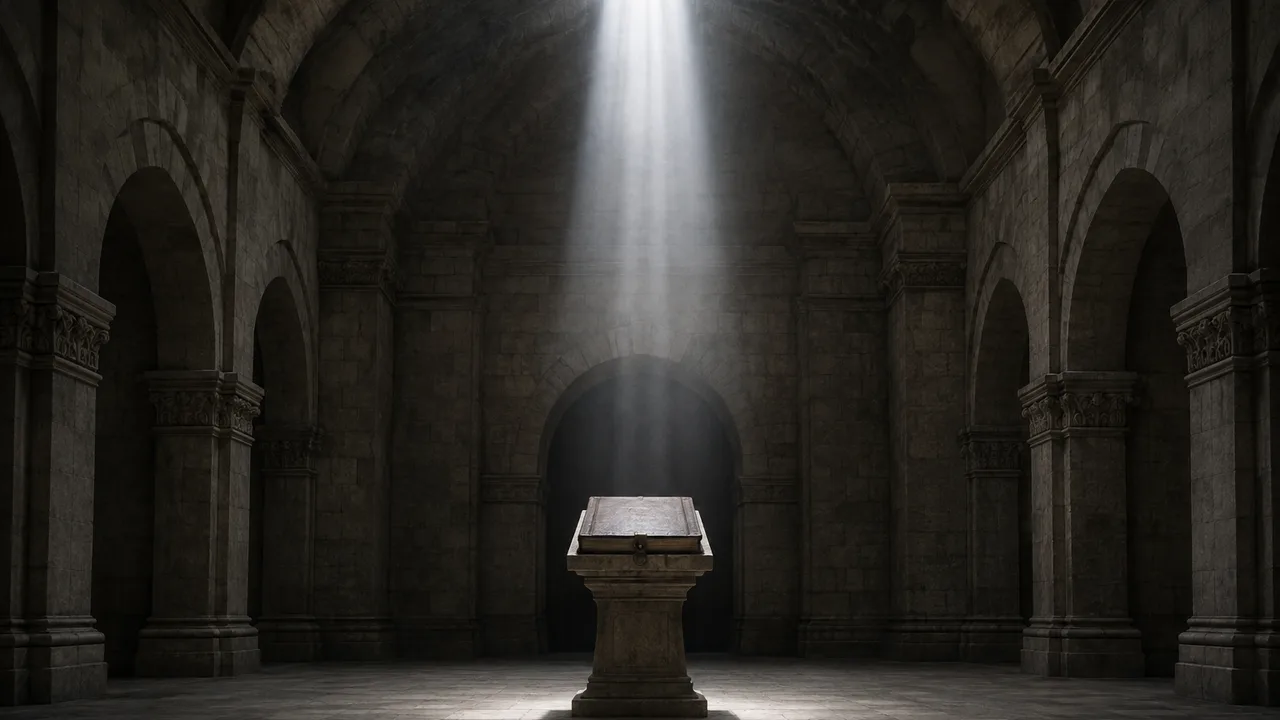
Before the world existed, there was a record. The Quran calls it the Preserved Tablet, where everything, down to a single falling leaf, was written first.
There is an idea in the Quran so vast that most of us walk past it without slowing down, and it quietly changes the whole shape of reality once you sit with it. The idea is that behind the world we can see, there is a record we cannot, a master document in which everything that happens was written before it happened. The Quran gives it a name: al-Lawh al-Mahfuz, the Preserved Tablet. It is one of the matters of the unseen, so we will not pretend to know its shape or its substance, because Allah did not tell us those. But what He did tell us about it is enough to reorder how a believer looks at every leaf that falls and every word of the Book in their hands.
The first surprising thing the Quran says is that the Quran itself was there before it ever reached us. "But this is an honored Quran, inscribed in a Preserved Slate" (85:21 to 22). And again: "Indeed, it is a noble Quran, in a Register well-protected" (56:77 to 78). The revelation that Muslims recite today did not begin its existence when Jibril first spoke to the Prophet Muhammad ﷺ in the cave. It was already written, already honoured, already kept safe in the Preserved Tablet, and what descended to earth was a sending-down of something that was securely established above.
That is why the word preserved matters so much. The Tablet is not a rough draft or a place where things get lost. It is protected, guarded, beyond corruption. The Quran's own promise that it will never be altered has its root here, in the fact that its source is a record no hand can reach to change.
The Preserved Tablet is not only for scripture. The Quran extends it to the entire texture of existence, and it chooses the smallest possible example to make the point unforgettable. "And with Him are the keys of the unseen; none knows them except Him. And He knows what is on the land and in the sea. Not a leaf falls but that He knows it. And no grain is there within the darknesses of the earth and no moist or dry thing but that it is written in a clear record" (6:59).
Sit with the scale of that. A single leaf, somewhere on the earth, detaching from a branch and drifting down in a forest no human eye is watching, is known to Allah and is in a clear record. Every seed buried in the dark soil, every drop in every sea, the wet and the dry of all things, all of it accounted for and written. The universe is not a chaos of random events that Allah reacts to. It is an authored reality, and the Preserved Tablet is where the authorship is kept. Nothing in your life is happening off the page.
That single fact carries two feelings at once, and a believer is meant to hold both. The first is awe. To live inside a reality where nothing, not one falling leaf, escapes the record is to live under a knowledge so complete it should make a person careful, honest, and humble. There are no unwitnessed corners.
The second is comfort, and it is the deeper of the two. If not a leaf falls without being known and written, then nothing that happens to you is an accident that slipped past Allah. The loss you did not see coming, the door that closed, the delay that broke your heart, none of it is a system failure. It was known before the world began and recorded in a place that cannot be corrupted. That does not make pain painless, but it removes the specific terror of randomness, the fear that your life is at the mercy of chaos. It is at the mercy of an Author who wrote it, and who is the Most Merciful.
There is one verse that adds a layer many people find surprising, and honesty requires presenting it as the scholars do, with its genuine differences intact. "Allah eliminates what He wills or confirms, and with Him is the Mother of the Book" (13:39). The Mother of the Book is understood to be the ultimate, fixed record. But the first half of the verse speaks of Allah erasing and establishing, and the commentators did not all read it the same way. Some understood it to mean that certain lower records can be altered by Allah's will, that things like a lifespan or a provision may be changed through means He Himself decreed, such as sincere supplication or ties of kindness, while the ultimate Book remains unchanged. Others read the verse in connection with the abrogation of rulings in revelation. The point for a believer is not to force a single answer where the scholars held more than one, but to notice what the verse guards: that Allah is never bound by His own record the way a prisoner is bound by a wall. He writes, and He is sovereign over what He writes.
Here is where the Preserved Tablet stops being abstract. Knowing that everything is written does not cancel your effort, because your effort was written too. Your prayers are on the page. Your striving, your choices, the good you reach for, all of it is part of the record, not excluded from it. A believer does not respond to the Tablet by going limp and saying it is all decided, because the very act of trying is one of the things that was decided. Instead the believer responds with a strange and steady calm: I will do my utmost, and I will not be crushed by the outcome, because the outcome was never in my hands or in the hands of chance. It was with the One who wrote not a leaf falls but that He knows it.
So what is the Preserved Tablet? It is the answer to whether the world is authored or accidental, and the Quran's answer is unambiguous. Reality has a record, kept safe beyond all reach, holding the Book we recite and the leaf we never see fall. We do not know its form, and we were not asked to. We were only asked to live like people who know that nothing is unwritten, and to let that knowledge make us both humble and unafraid.
Silsila Research Desk
Grade: Sahih · 7 min read