
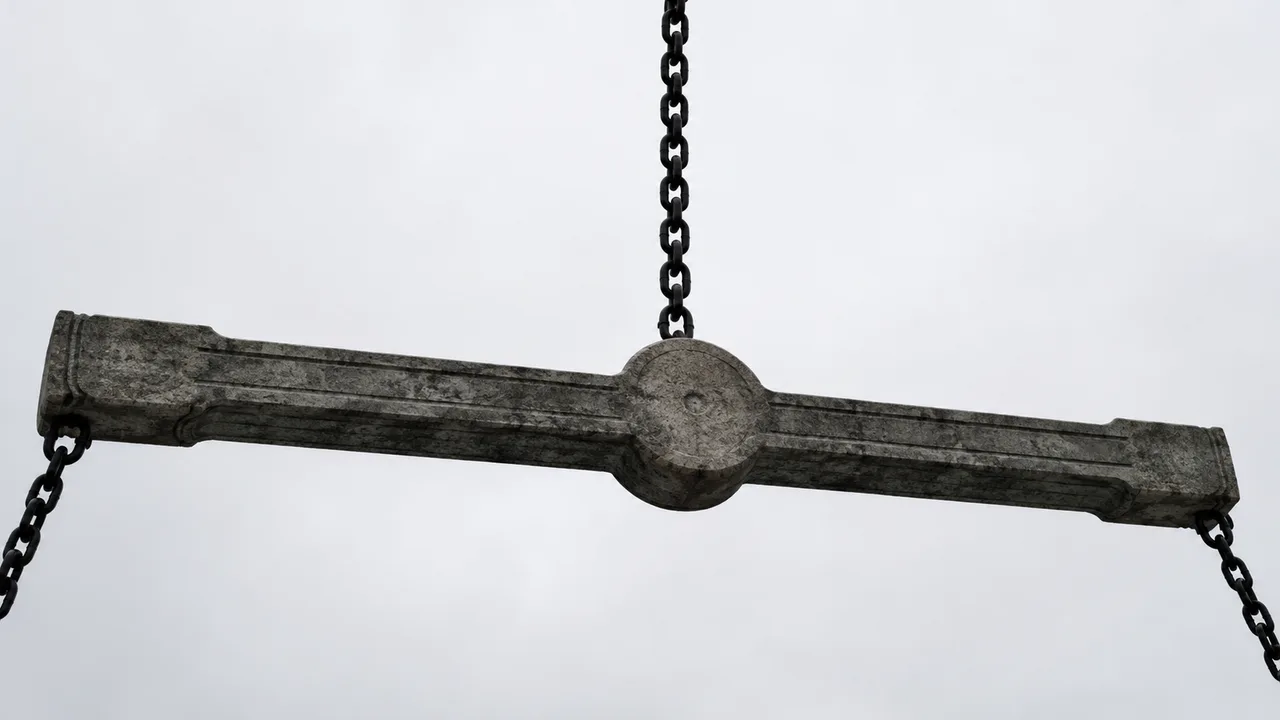
Ninety nine scrolls of sin on one pan. One small card on the other. The card wins. What the Mizan weighs, and why nothing is ever lost.
Ninety nine scrolls are unrolled in front of one man, one after another, each of them running out to the place where his eyesight gives up. Every mark on every scroll is his own, and the whole of creation is watching them counted. Then something small is produced. A card, the kind of thing you could close your hand around. The scrolls go into one pan. The card goes into the other. And the pan holding the card sinks.
That instrument is the Mizan. The Mizan is the scale Allah sets up on the Day of Resurrection to weigh what every human being actually did, and the Quran states its purpose without softening it: "And We place the scales of justice for the Day of Resurrection, so no soul will be treated unjustly at all. And if there is even the weight of a mustard seed, We will bring it forth. And sufficient are We as accountant" (21:47). Nothing is skipped. Nothing is padded. Every person finds out that day which of their two pans is heavier, and everything after that depends on the answer.
Look at what the verse promises before it promises anything else. The scales are described as scales of justice, and the very next clause explains why that matters: so that no soul is wronged at all. Ibn Kathir, commenting on this verse, notes that although the Quran uses the plural, most scholars hold that it is one Balance, and that the plural form reflects the sheer number of deeds it will weigh. As-Sa'di puts the mercy inside it plainly in his commentary: no soul, believing or not, will have a good deed subtracted from it or a sin added to it.
That is not a small guarantee. Think of every time you were blamed for something you did not do, or did something good and watched someone else take the credit. Every one of those files is still open. On that day they are closed correctly, in public, by a Judge who needs no witnesses because He was there.
Then the verse shrinks the unit down to a mustard seed, the smallest thing a seventh century Arabian audience could hold in their mind. Surah az-Zalzalah shrinks it further. "So whoever does an atom's weight of good will see it, and whoever does an atom's weight of evil will see it" (99:7-8). Read the second half slowly, then read the first half again. The same sensitivity that catches your smallest sin catches your smallest kindness.
The Quran states the outcome of the weighing three separate times, and the wording barely changes. "And the weighing of deeds that Day will be the truth. So those whose scales are heavy, it is they who will be the successful. And those whose scales are light, they are the ones who will lose themselves for what injustice they were doing toward Our verses" (7:8-9). Again in Surah al-Muminun: "And those whose scales are heavy, it is they who are the successful. But those whose scales are light, those are the ones who have lost their souls, being in Hell, abiding eternally" (23:102-103).
Surah al-Qariah gives the same two outcomes inside a world coming apart. "It is the Day when people will be like moths, dispersed, and the mountains will be like wool, fluffed up. Then as for one whose scales are heavy, he will be in a pleasant life. But as for one whose scales are light, his refuge will be an abyss. And what can make you know what that is? It is a Fire, intensely hot" (101:4-11). Mountains gone soft as combed wool, people scattered like insects around a lamp, and in the middle of that noise, a scale quietly deciding everything.
Here is where the Mizan stops being frightening arithmetic and starts being strange. What is heavy on it is not what looks heavy here.
The Prophet Muhammad ﷺ said that there are two phrases light upon the tongue, heavy in the balance, and beloved to the Most Merciful: Subhan Allahi wa bi hamdihi, Subhan Allahi'l-Adhim. Glory be to Allah and praise Him, glory be to Allah the Magnificent. Seconds to say. Free. Say them in the gap before your next thought and something on the correct pan moves. He ﷺ also said that alhamdulillah fills the scale.
And Allah does not simply record the good, He inflates it. "Indeed, Allah does not do injustice, even as much as an atom's weight, while if there is a good deed, He multiplies it and gives from Himself a great reward" (4:40). Sins are counted exactly. Good deeds are counted and then multiplied. That asymmetry is deliberate, and it is the only reason anyone has a chance.
The reverse is also true, and the Quran is not gentle about it. "Those are the ones who disbelieve in the verses of their Lord and in their meeting Him, so their deeds have become worthless, and We will not assign to them on the Day of Resurrection any weight" (18:105). Ibn Kathir explains the phrase simply: their Balance will not be made heavy, because there is no good in it to make it heavy.
The Prophet ﷺ attached an image to that verse that nobody forgets. A great, heavy man will be brought on the Day of Resurrection, and with Allah he will not weigh the wing of a mosquito. Then he ﷺ told them to recite that very verse if they wished. All that presence, all that room he took up, and the needle does not move.
Now go back to the man with the ninety nine scrolls, because his story is transmitted from Abdullah ibn Amr ibn al-As (RA). The Prophet ﷺ described a man of this ummah called forward in front of all creation. Ninety nine scrolls of his record are spread out, each running to the horizon. He is asked whether he denies any of it, whether the recording angels wronged him. He says no. He is asked whether he has an excuse. He has none.
Then a single card is brought out. On it is written: I bear witness that there is no deity but Allah, and I bear witness that Muhammad ﷺ is His servant and His Messenger. The man cannot see what one card is supposed to do against all of that. The scrolls are placed in one pan, the card in the other. The scrolls fly up, and the card is heavier, for nothing is heavier than the name of Allah.
Sit with that before you file it away as comfort. He was not saved by having fewer scrolls. He was saved by a word he had spoken and meant, weighed by the One who knows exactly how much of it he meant.
Ibn Kathir records a report in his commentary on the mustard seed verse. A Companion came to the Prophet ﷺ and said he owned slaves who lied to him, betrayed him and disobeyed him, and that he beat them and insulted them, and he wanted to know where that left him. The Prophet ﷺ told him that what they had done would be measured against what he had done to them, and that whatever his punishment exceeded their offences would be taken from him on that day.
The man began to weep. The Prophet ﷺ asked whether he had not read the words of Allah about the scales of justice and the mustard seed. The man said he saw nothing better than to be rid of the whole problem, and freed every one of them on the spot. He did not wait for the Day of Resurrection to find out how his weighing would go.
The scale is not the last station. Beyond it lies the Sirat, the bridge over Jahannam that every person is brought to.
Which means the pan is still open right now. Every atom's weight is still being logged, in both directions, including the ones nobody watching you noticed. So the honest question is not what the Mizan is. It is what you have put on it since this morning.
Silsila Research Desk
Grade: Sahih · 7 min read