
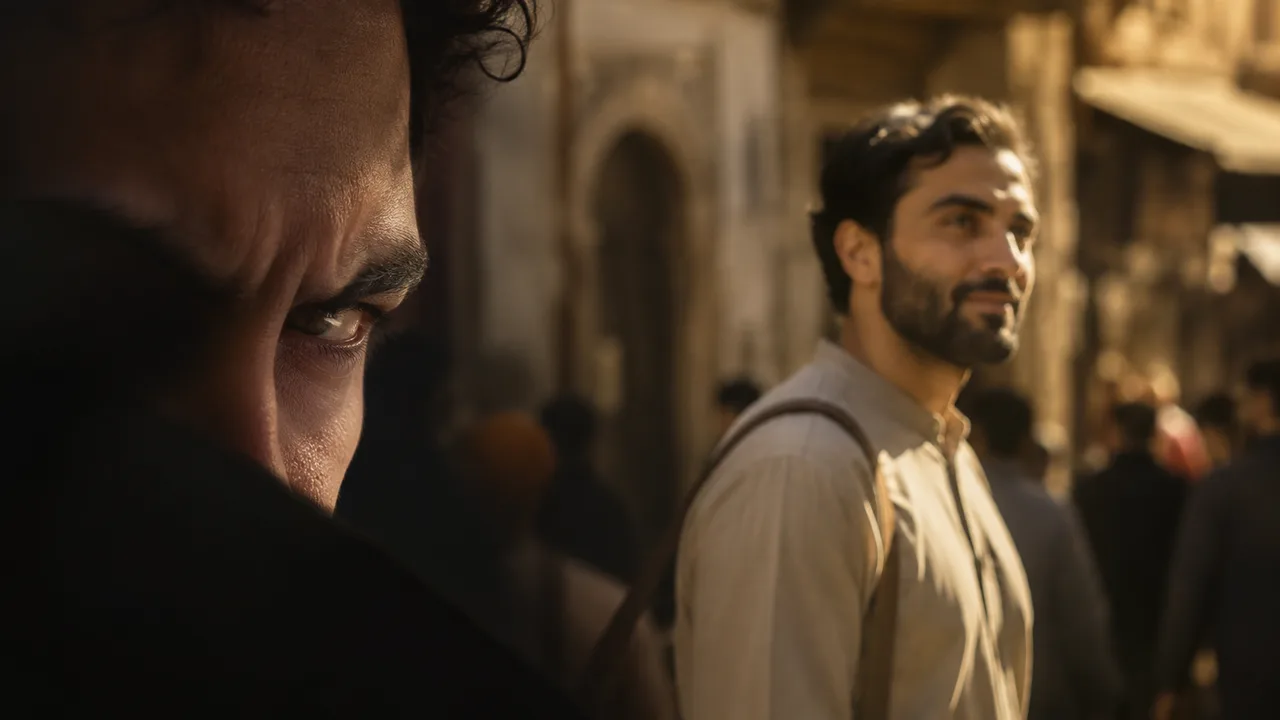
A man admired his friend's skin out loud and the friend collapsed. The evil eye is envy that lands, and what was transmitted for it is words and water.
A man was washing when another man walked past, looked at him, and said out loud that he had never in his life seen skin so beautiful. Sahl ibn Hunayf (RA) dropped where he stood. He was brought to the Prophet Muhammad ﷺ, and the first question the Prophet ﷺ asked was not what fever this was or what he had eaten. He asked who they suspected.
That is the evil eye in Islam. Not a shape. Not a symbol. Not a curse someone mutters over you. It is envy leaving a person and landing on the thing envied, and it does real damage by Allah's permission. The Prophet ﷺ said it in two words: the effect of an evil eye is a fact (Sahih al-Bukhari 5740). Everything he ﷺ taught for it is words and water. Nothing hangs from a string.
The Quran does not name an eye. It names the person behind it. Say, I seek refuge in the Lord of daybreak, from the evil of that which He created, and from the evil of darkness when it settles, and from the evil of the blowers in knots, and from the evil of an envier when he envies (113:1 to 5). Read that last line again. Not the envier all the time. The envier when he envies, in the moment the feeling actually moves.
This is why the man in the valley matters so much. 'Amir ibn Rabi'ah (RA) was a Companion. He was not casting anything. He looked at his brother, felt something rise, and said it out loud, and his brother hit the ground. When the Prophet ﷺ was told who it was, he did not call it magic. He said, why would anyone of you kill his brother, and then gave the correction that fixes it at the root. If he sees something that he likes, then let him pray for blessing for him (Sunan Ibn Majah 3509).
That is the whole difference. Two men can look at the same beautiful thing. One says may Allah bless it for you and the look carries nothing. The other says nothing out loud, and the envy goes out anyway.
Here is where most people go wrong in both directions, either laughing the whole thing off or being terrified of it. Ibn 'Abbas (RA) reported the Prophet ﷺ saying that the influence of an evil eye is a fact, and if anything would precede the destiny it would be the influence of an evil eye, and when you are asked to take a bath as a cure from it, take the bath (Sahih Muslim 2188).
Sit with the shape of that sentence. If anything would precede the decree. If. Nothing does. The eye is being described as the closest thing there is to overtaking what Allah has already written, and it still does not overtake it. That is not a small comfort. It is the entire frame.
The Quran shows the same balance in a father's mouth. Ya'qub (AS) sent his sons into Egypt and told them not to walk in through one gate. And he said, O my sons, do not enter from one gate but enter from different gates, and I cannot avail you against the decree of Allah at all. The decision is only for Allah, upon Him I have relied, and upon Him let those who would rely indeed rely (12:67). Ibn Kathir records that Ibn 'Abbas (RA), Mujahid, Qatadah and others read this as a father fearing the eye for sons who were striking to look at. And Ibn Kathir points straight at the second half of the ayah, that the precaution changed nothing against Allah's decision, it was a need in Ya'qub's (AS) own heart that he discharged. Take the precaution. Do not think the precaution is what saved you.
There is a third place the eye surfaces in the Quran, aimed at the Prophet ﷺ himself. And indeed, those who disbelieve would almost make you slip with their eyes when they hear the message, and they say, indeed, he is mad (68:51). Ibn Kathir records Ibn 'Abbas (RA) and Mujahid reading that as exactly what it sounds like, men trying to knock him down by looking at him, and failing because Allah was guarding him.
Go back to Sahl (RA), lying unconscious with a crowd around him. The Prophet ﷺ called for water. He told 'Amir (RA) to wash his face, his arms to the elbows, his knees, and the inside of his lower garment into the vessel, and then had that water poured over Sahl (RA). Sahl (RA) recovered (Sunan Ibn Majah 3509).
No object was used. No knot was tied. The man whose look caused it was made part of the cure.
'Aisha (RA) said the Prophet ﷺ ordered that ruqyah be done for the eye (Sahih al-Bukhari 5738). Anas ibn Malik (RA) reported that ruqyah was permitted for the sting, for pustules, and for the eye (Sahih Muslim 2196a). Ruqyah here means recitation over a person, nothing more exotic than that.
And there is a narration where the Prophet ﷺ is the one being treated. Abu Sa'id al-Khudri (RA) reported that Jibril (AS) came to him and asked whether he was ill. He said yes. And Jibril (AS) said over him, in the name of Allah I recite over you, from everything that harms you, from the evil of every soul or every envious eye. May Allah cure you. In the name of Allah I recite over you (Sahih Muslim 2186).
Read who is saying it and over whom. The best of creation, treated by an angel, with a sentence any Muslim can say.
'Aisha (RA) said that whenever the Messenger of Allah ﷺ became sick he would recite al-Mu'awwidhat, Surah al-Falaq and Surah an-Nas, and blow over himself, and that when his illness grew heavy she recited them over him and passed his own hands over his body (Sahih al-Bukhari 5016). 'Uqbah ibn 'Amir (RA) reported him ﷺ saying about the night they came down, verses have been sent down tonight the like of which has never been seen (Sahih Muslim 814a).
One of them names the envier outright. The other closes the last door: Say, I seek refuge in the Lord of mankind, the Sovereign of mankind, the God of mankind, from the evil of the retreating whisperer, who whispers evil into the breasts of mankind, from among the jinn and mankind (114:1 to 6). Both jinn and men. The whisper that starts the envy, and the envy that leaves the eye.
Ibn 'Abbas (RA) said the Prophet ﷺ used to seek refuge for al-Hasan and al-Husayn (RA) and say that their forefather Ibrahim (AS) used to do this same thing for Ismail (AS) and Ishaq (AS): I seek refuge for you two in the perfect words of Allah, from every devil, and from poisonous creatures, and from every evil, envious eye (Sahih al-Bukhari 3371).
A grandfather standing over two small boys, saying the same words a prophet said over his sons centuries earlier. That is the transmitted protection for a child. Words.
The blue glass eye on a keyring. The open hand hung over a doorway. The thread on a newborn's wrist, the pin on the inside of a shirt, the charm bought at a stall outside a shrine. None of it appears in anything transmitted from the Prophet ﷺ. Not once. He was asked about the eye, he confirmed it, he was brought a man flattened by it, and what he called for was water and speech.
What is transmitted is that on one journey he ﷺ sent an order that not a single cord necklace was to be left on any camel's neck without being cut off (Sahih al-Bukhari 3005).
So the eye is real, and the answer to it was never an object. It is a mouth that blesses instead of envying, two surahs at night, a du'a over your children, water when it is asked for, and the settled knowledge that the closest thing to overtaking the decree still does not overtake it. When you next see something of your brother's that you want, which of the two men in that valley are you going to be?
Silsila Research Desk
Grade: Sahih · 7 min read