
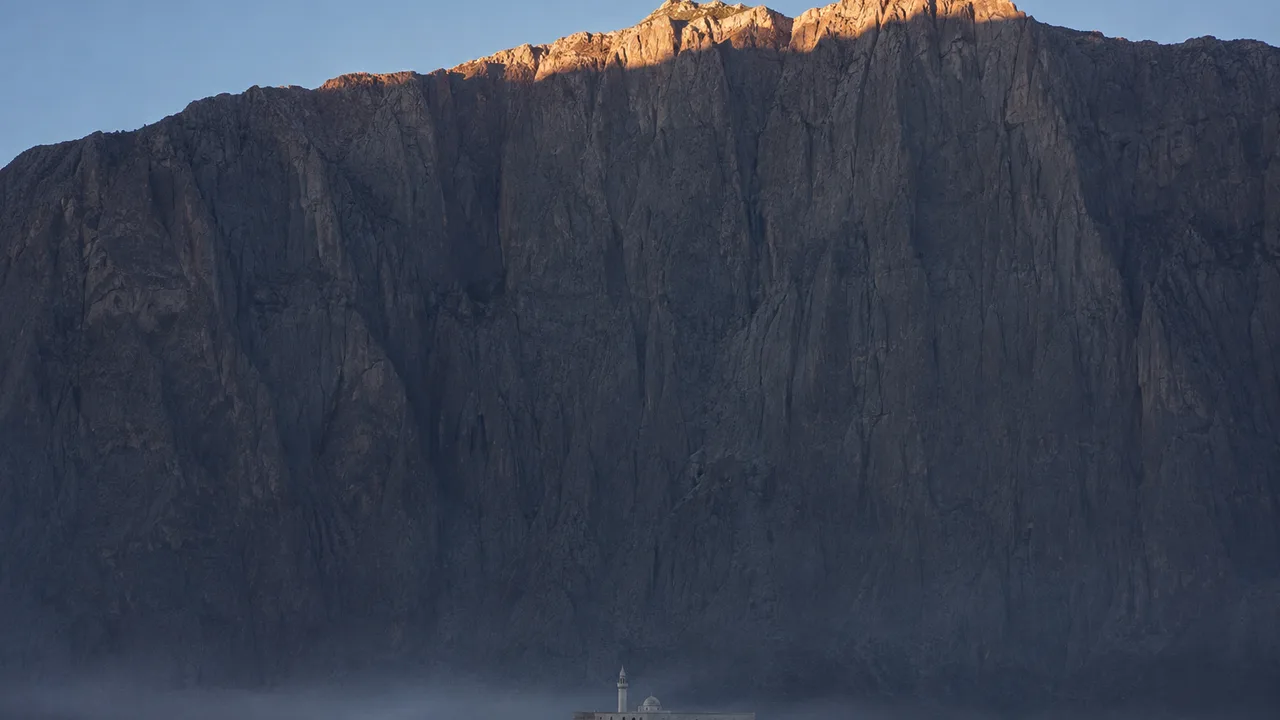
Akbar is a comparative, not the word for great. Greater than what? The classical scholars answer the half of the sentence that Arabic left out.
"Allah is great" is what the subtitles say, and the phrasebooks. It is the wrong word. Great in Arabic is *kabir*. *Akbar* is a different shape of the same root, the shape Arabic reaches for when it measures one thing against another, the shape behind bigger, older, nearer, greater. Which means the phrase that opens every Muslim prayer is not a description of Allah at all. It is a comparison. And it stops dead before telling you what the comparison is against.
Greater than what, then. Ibn Hajar answers in one line, in the glossary of his commentary on Sahih al-Bukhari where he works through hard words letter by letter. On "Allahu akbar" he writes that it is said to mean al-Kabir, the Great, and it is said to mean greater than everything, with the second half of the comparison dropped because the meaning is obvious. That is the missing piece. The sentence in full is that Allah is greater than everything, and Arabic left the everything out. What the classical scholars put into that gap is the real question.
Ibn Manzur gathers the views under the root k-b-r in Lisan al-Arab, and they do not agree. Some, he reports, take *akbar* here as standing in for plain *kabir*, a comparative doing an adjective's job. Sibawayh took the other road: the phrase is an ellipsis, greater than everything, the way you tell someone they are better and never bother to add than whom. Al-Baghdadi preserves the same line in Khizanat al-Adab with Sibawayh's reason: he dropped it for lightness, because the listener already knows.
Ibn Manzur names the pressure behind the argument. The comparative pattern in Arabic, what grammarians call *af'al al-tafdil*, the "more X than" form, cannot stand on its own two feet. It has to be made definite with the article, or joined to a following noun, or given a "than" with something after it. "Allahu akbar" has none of the three. Something has been left out, and every commentary since is an argument about what.
The Quran does it too. "Indeed, prayer prohibits immorality and wrongdoing, and the remembrance of Allah is greater" (29:45).
Greater than what. The verse does not say. Al-Alusi works through it in Ruh al-Ma'ani and states the grammar flatly: the object has been deleted, and so has the thing being compared against. Then he lists the fillings. Ibn Abbas (RA), Ibn Mas'ud (RA) and Ibn Umar (RA), with Mujahid and others, read it as Allah's remembrance of you being greater than your remembrance of Him. Others read it as greater than everything. It happens again in Surah al-Tawba: a promise of gardens and rivers breaks off into "but approval from Allah is greater" (9:72), the other end unsaid.
Al-Razi gives four readings of the opening takbir in Mafatih al-Ghayb. The first is less an explanation than an instruction.
Before you say it, take stock. Hold your own limbs and faculties in mind. Then every mineral and plant and animal, the seas and mountains and deserts, down to the specks of dust. Then rise to the lowest heaven, for all its vastness, and keep rising to the Lote Tree of the Furthest Boundary, the Tablet, the Pen, the Garden, the Fire and the mighty Throne. Then cross from the world of bodies into the world of spirits, and past even that, since Allah says none knows the soldiers of your Lord except Him. When the whole inventory is standing in your mind at once, al-Razi says, then say Allahu akbar. And what you mean by *akbar* is that He is beyond resembling any of it, beyond the intellect being allowed to set Him beside it for comparison at all.
His second reading hangs on the hadith of ihsan, which he quotes: that you worship Allah as though you see Him, and if you do not see Him, He sees you. So, in al-Razi's words, Allah is greater than that He should not see me, and greater than that He should not hear my speech.
His third: greater than that the minds and imaginations of created things could reach Him. He sets a line of 'Ali ibn Abi Talib (RA) beside it. Tawhid is that you do not imagine Him.
His fourth: greater than that creation could ever discharge what His servitude has a right to. Their obedience falls short of serving Him, their praise falls short of His greatness, their knowledge falls short of the depth of Him. And a warning for anyone who enjoyed that climb too much. Even if your mind held every wonder of bodies and spirits, do not tell yourself you have reached the outskirts of His majesty.
Samura (RA) narrated in Sahih Muslim that the most beloved speech to Allah is four, and it does no harm which you begin with: *subhan Allah*, *al-hamdu lillah*, *la ilaha illa Allah*, *Allahu akbar*. Ibn Hajar collects the commentary, and al-Baydawi makes an observation easy to read past. The first three are found in the Quran. The fourth is not.
The Quran commands it instead. Surah al-Isra closes on the order: "and glorify Him with great glorification" (17:111). That is *wa kabbirhu takbira*, the takbir verb twice over, and al-Mawardi's first reading is to describe Him as greater than everything. Surah al-Muddaththir gives the same order in two words: "And your Lord glorify" (74:3). And the same verb returns in the Ramadan verse, "and to glorify Allah for that to which He has guided you" (2:185).
Abu Musa (RA) said they were with the Prophet ﷺ on a journey, and whenever they climbed they shouted the takbir. He ﷺ turned to them. Go easy on yourselves, he said, for you are not calling upon one who is deaf or absent. You are calling upon One who hears and sees (Sahih al-Bukhari 6384).
That was the pattern of the road. Jabir (RA) described it as a rule with two halves: when we went up we said the takbir, and when we came down we said the tasbih, *subhan Allah*. Ibn Umar (RA) said the Messenger ﷺ, coming home from an expedition or hajj or umra, would say the takbir three times on every high place of the ground (Sahih al-Bukhari 6385).
Al-Muhallab explained the split and Ibn Hajar carried it into Fath al-Bari: the takbir on the way up makes the self feel the greatness of Allah at the moment the enormity of His creation opens out below the traveller. Ibn Hajar sharpens it later, in the book of supplications. Height is beloved to the human self, he writes, because of the feeling of greatness in it. So the man dressed in that feeling is instructed, right then, to mention the greatness of Allah, that He is greater than everything, and to say the takbir over it.
Read the timing again. Not at the bottom of the valley. At the top of the climb. The phrase is prescribed for the second when a man's chest lifts and he feels large.
The descent gets the other phrase, for the opposite reason. A low place is a tight place, Ibn Hajar writes, so the tasbih is prescribed there because it is a cause of relief, the way it was for Yunus (AS) when he glorified Allah in the darknesses and was brought up out of his distress.
So "Allah is great" is not wrong the way a lie is wrong. It is wrong the way half a sentence is wrong. Great is a fact about Allah you can note and walk away from. Greater is a fact about Allah and about you in the same breath, because a comparison has two ends and you are standing on one of them.
That is why the second term was never named. Whatever you were about to weigh Him against, at the top of the ridge, in the first second of the prayer, in the room where your name is being said well, goes into the blank. And it loses.
Silsila Research Desk
Grade: Sourced · 7 min read