
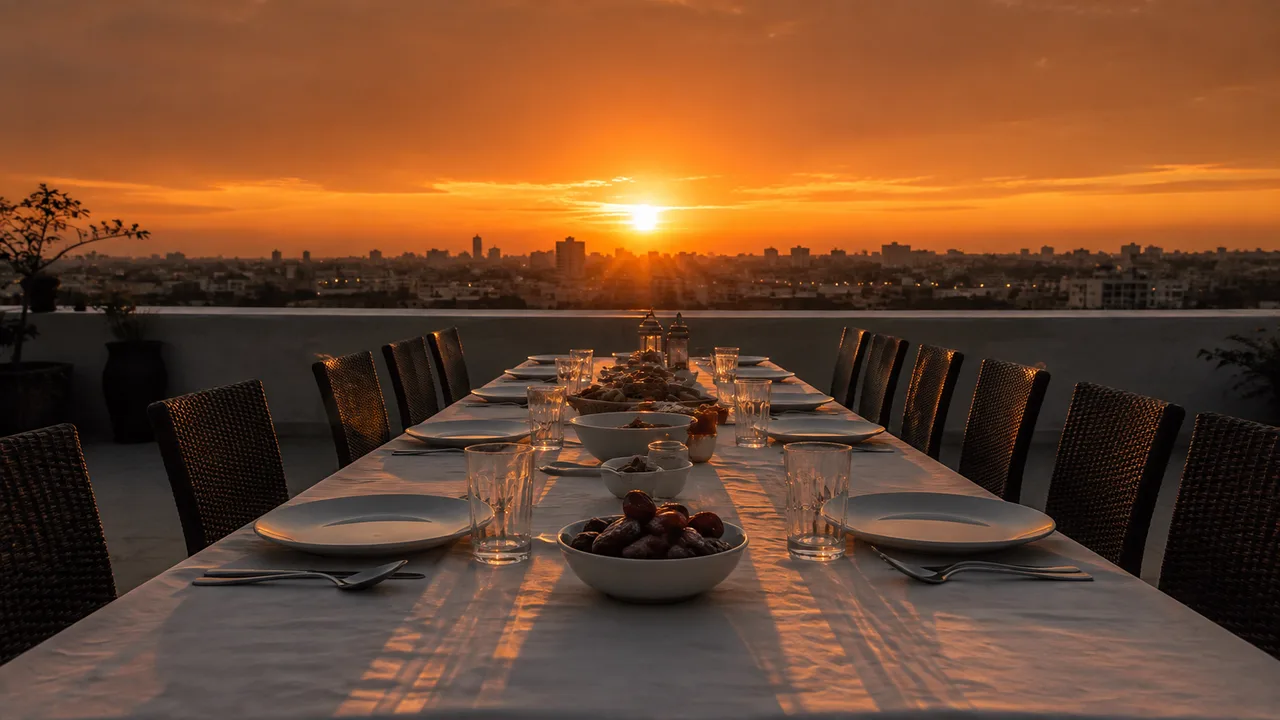
A billion people give up food, water and desire from dawn to dusk for a month. The stated reason is one word, and the reward has no stated number.
Every year, for one lunar month, over a billion human beings voluntarily stop eating, drinking, and satisfying desire from first light to sunset. No law enforces it; no one checks. A businessman alone in a hotel room, a student in an empty flat, a farmer in a field with a water bottle in reach: each could break the fast in perfect secrecy, and each does not. Why? The Qur'an gives the command and its purpose in a single verse: "O you who have believed, decreed upon you is fasting as it was decreed upon those before you, that you may become righteous" (2:183). That you may attain taqwa. One target word. Everything else about Ramadan, the chosen month, the strange privacy of the deed, the unnumbered reward, the gate with a name, unfolds from understanding what that word is doing.
Notice the verse's first move: as it was decreed upon those before you. Fasting is not an Islamic invention; it is the oldest spiritual technology on record, prescribed to every community of believers in history. The Qur'an is telling you upfront that this is not arbitrary hardship. It is the standard curriculum of the human soul, renewed one final time.
And the goal, taqwa, is best translated by what the fast actually builds. All day, the fasting person says no to permitted things, food he owns, water he could reach, on no authority except that Allah is watching. Repeat that refusal a thousand small times a day for a month, and something changes: the sense of being seen by Allah stops being a doctrine and becomes a reflex. That reflex is taqwa. The person who can decline lawful bread at noon because of Allah finds it far easier to decline unlawful money on an ordinary Tuesday. Ramadan is thirty days of resistance training for the conscience.
The month was not drawn from a hat: "The month of Ramadan is that in which was revealed the Qur'an, a guidance for the people and clear proofs of guidance and criterion" (2:185). Ramadan is the Qur'an's arrival month; the fast is, among other things, an annual anniversary of the moment heaven resumed contact with earth. That is why the two acts intertwine all month, fasting by day, long recitation by night, and why Laylatul Qadr, the revelation's own night, sits in its final stretch.
The same verse pre-empts the fear that this is a religion of harshness: the ill and the traveller are excused to other days, "Allah intends for you ease and does not intend for you hardship" (2:185). The command comes with its own mercy clauses attached, in the same breath.
And then, placed by Allah in the very middle of the fasting passage, comes a verse that seems to interrupt, and does not: "And when My servants ask you concerning Me, indeed I am near. I respond to the invocation of the supplicant when he calls upon Me" (2:186). The scholars never missed the placement. In the month of empty stomachs, the nearest verse in the Qur'an: I am near. Hunger hollows a space, and the du'a fills it.
Every other good deed in Islam has a published exchange rate, multiples of ten, of seven hundred. Fasting alone is priced off the books, in a hadith qudsi: "Every deed of the son of Adam is for him, except fasting; it is for Me, and I shall reward it."
Why this one? Because fasting is the only major act of worship that is invisible. Prayer can be seen, charity can be traced, pilgrimage has witnesses. A fast exists nowhere except between the servant and his Lord; the hotel room proves it daily. So Allah took the one deed that cannot be performed for an audience and reserved its wage for Himself, adding, in the same narration, that the breath of the faster is sweeter to Him than musk, and that the faster has two joys: one at breaking the fast, and one at meeting his Lord.
The Prophet ﷺ described the month's opening ceremony: when Ramadan comes, the gates of Paradise are opened, the gates of Hell are closed, and the devils are chained. And for the finishers, a detail of staggering intimacy: in Paradise there is a gate called ar-Rayyan, through which those who fasted will enter on the Day of Resurrection, and no one else; when they have entered, it is closed. An entrance built for the people of the hidden deed, as private in eternity as the deed was in life.
Add the headline offer, and the month's economics are complete: whoever fasts Ramadan out of faith and seeking reward, his past sins are forgiven. A year's ledger, cleared in thirty days.
So why do Muslims fast in Ramadan? Because taqwa cannot be read into existence; it has to be trained, and hunger is the oldest gym. Because the month of the Qur'an deserves a month of the body's attention. Because one deed in the religion is priced personally by Allah, and this is it. Ask anyone who has completed the month honestly and they will confirm the paradox the texts promise: no one is fed by food alone, and nobody feels fuller than the one who gave it up for his Lord, standing at sunset with a date in his hand and the first of his two joys already arriving.
Silsila Research Desk
Grade: Sahih · 6 min read