
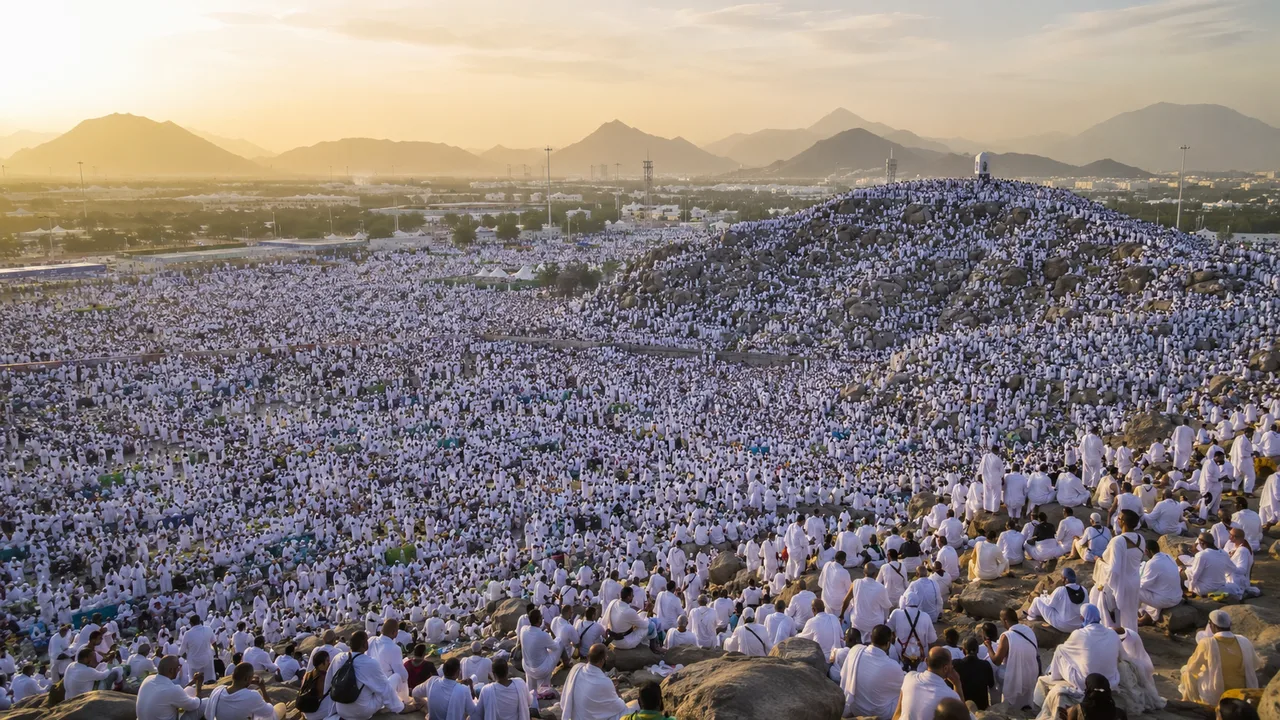
On one afternoon each year, Allah frees more people from the Fire than on any other day, and He boasts about the crowd to His angels: what do these want?
There is one afternoon on the calendar when, according to the Prophet Muhammad ﷺ, Allah frees more people from the Fire than at any other time of the year. Not a night hidden in a month, not a season, one specific daylight stretch on the ninth of Dhul-Hijjah, on a plain a few kilometres outside Makkah. The hadith describing it contains a scene almost too intimate to paraphrase: Allah draws near, and He boasts about the gathered crowd to His angels, and He asks a question about them. Understanding that question is understanding the whole day.
Strip hajj to its essence and one rite remains. The Prophet ﷺ compressed it into three words: Hajj is Arafah. Pilgrims who miss the tawaf can repair it; miss the standing at Arafah and there is no hajj that year. And what is the rite? Almost nothing, physically. No structure to circle, no stones to cast, no ritual choreography. Millions of people simply stand on an open plain from midday to sunset, facing their Lord, and ask.
That emptiness is the design. Every other act of worship has a form that can distract from its content. Arafah removes the form. You stand in the sun in two plain cloths that look exactly like your burial shroud, stripped of rank, brand and passport, in a crowd that looks like a rehearsal of the resurrection, and the only thing left to do is talk to Allah. The Quran's single instruction about the day treats departure, not arrival, as the event: "But when you depart from Arafat, remember Allah at al-Mash'ar al-Haram" (2:198). Even leaving the plain is scheduled around remembrance.
One Arafah in history carried a revelation. A Jewish scholar once said to Umar (RA): there is a verse in your Book which, had it been revealed to us Jews, we would have taken that day as a festival. He meant this verse: "This day I have perfected for you your religion and completed My favor upon you and have approved for you Islam as religion" (5:3).
Umar (RA) answered that he knew exactly when and where it came down: on the Day of Arafah, on a Friday, while the Prophet ﷺ was standing at Arafah during his Farewell Hajj. The completion certificate of the entire religion was issued on this plain, on this day, to a man standing exactly where the pilgrims stand now. The scholar wished it were a festival; Umar's (RA) reply implies the quiet answer, it already is. Two, in fact, for the day of that revelation was both a Friday and an Arafah.
Now the hadith the whole day orbits. The Prophet ﷺ said: there is no day on which Allah frees more of His slaves from the Fire than the Day of Arafah. He draws near, and He boasts of them before the angels, saying: what do these want?
Scholars have stood before that sentence for centuries. The angels once asked, when humanity was created, whether Allah would place on earth those who shed blood and spread corruption. On Arafah, the same humanity stands dusty and undone on a plain, and Allah turns to those same angels, not to defend us with arguments but to display us with pride. And the question, what do these want, is not a request for information; the One asking knows every heart on the plain. The books of tafsir and commentary read it as the language of a host delighting in his guests: look at them, they have left everything and come. Whatever they want, ask, and witness what I give.
Most Muslims, most years, are not on the plain. The day does not exclude them. For those not on hajj, the Prophet ﷺ attached an offer to Arafah that outbids any other single day of fasting: fasting the Day of Arafah expiates the sins of the previous year and the coming year. Two years wiped against one day without food and water. Note the precision of the fiqh: this fast is for the people at home. The pilgrims themselves do not fast it, following the Prophet ﷺ, who stood at Arafah unfasting so he would have strength for the real work of the day, which is dua.
And on that, the Prophet ﷺ named the day the summit of asking: the best supplication is the supplication of the Day of Arafah, and the best of what I and the prophets before me have said is: there is no deity but Allah alone, without partner; His is the dominion and His is all praise, and He is over all things able. The best dua of the best day is not a request list at all. It is tawhid. Get who Allah is right, and everything you would have asked for is already being handled.
So why is Arafah special? Because the religion was completed on it. Because its fast erases two years. Because its standing is the pillar of the pilgrimage. But under all of it is that one question echoing over the plain, what do these want?, and the secret the day teaches: the wanting is the worship. Nobody stands for hours in the desert sun for something they mildly prefer. Arafah is the yearly appointment where desire for Allah's forgiveness is expressed with the whole body, and answered on a scale no other day matches.
If you are on the plain, ask until sunset. If you are at home, fast, and when the afternoon comes, raise your hands anyway. The hadith does not say Allah boasts only about the ones who could afford the ticket. It says He frees His slaves from the Fire, and on this one afternoon, the gates are moving.
Silsila Research Desk
Grade: Sahih · 6 min read